

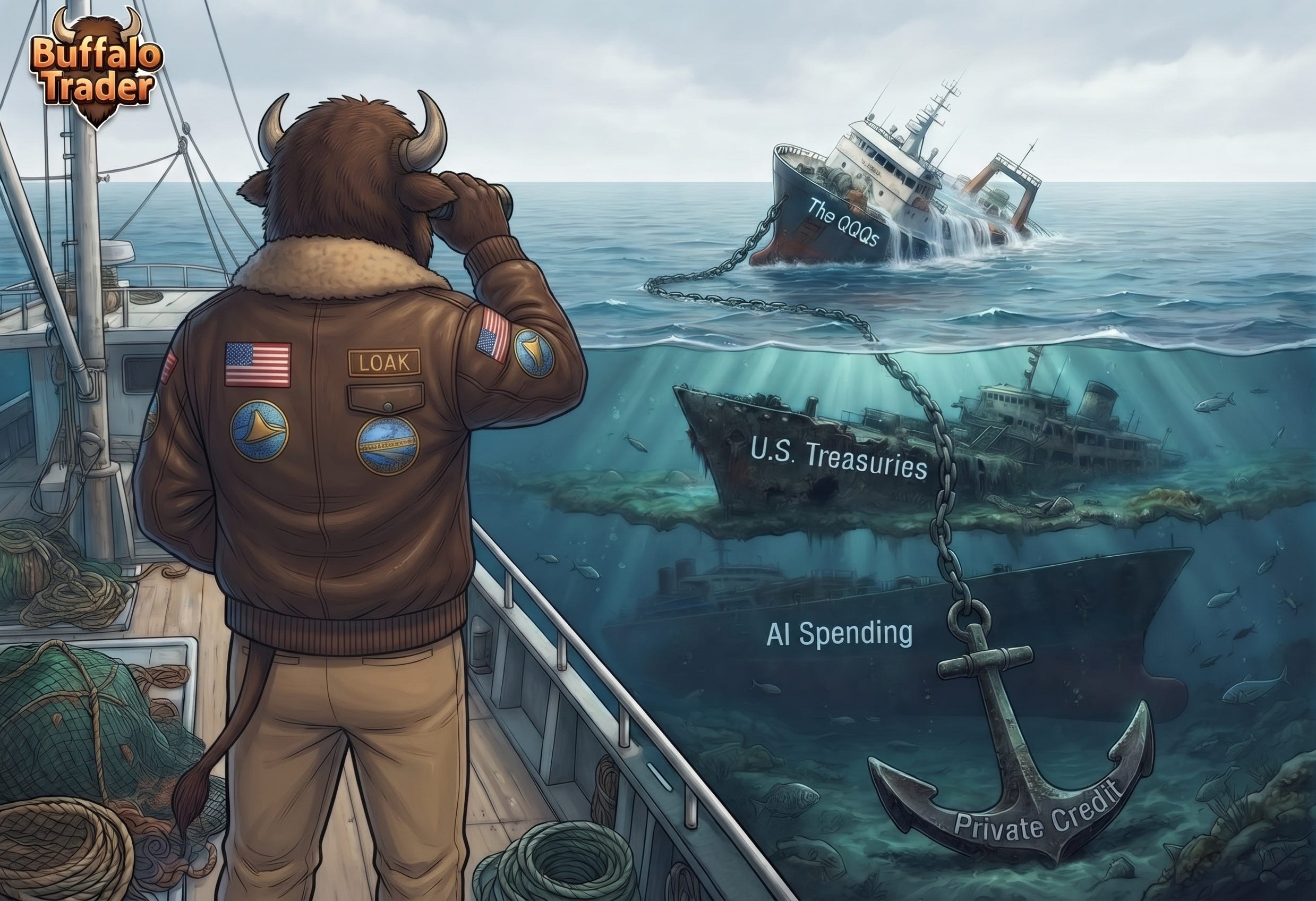
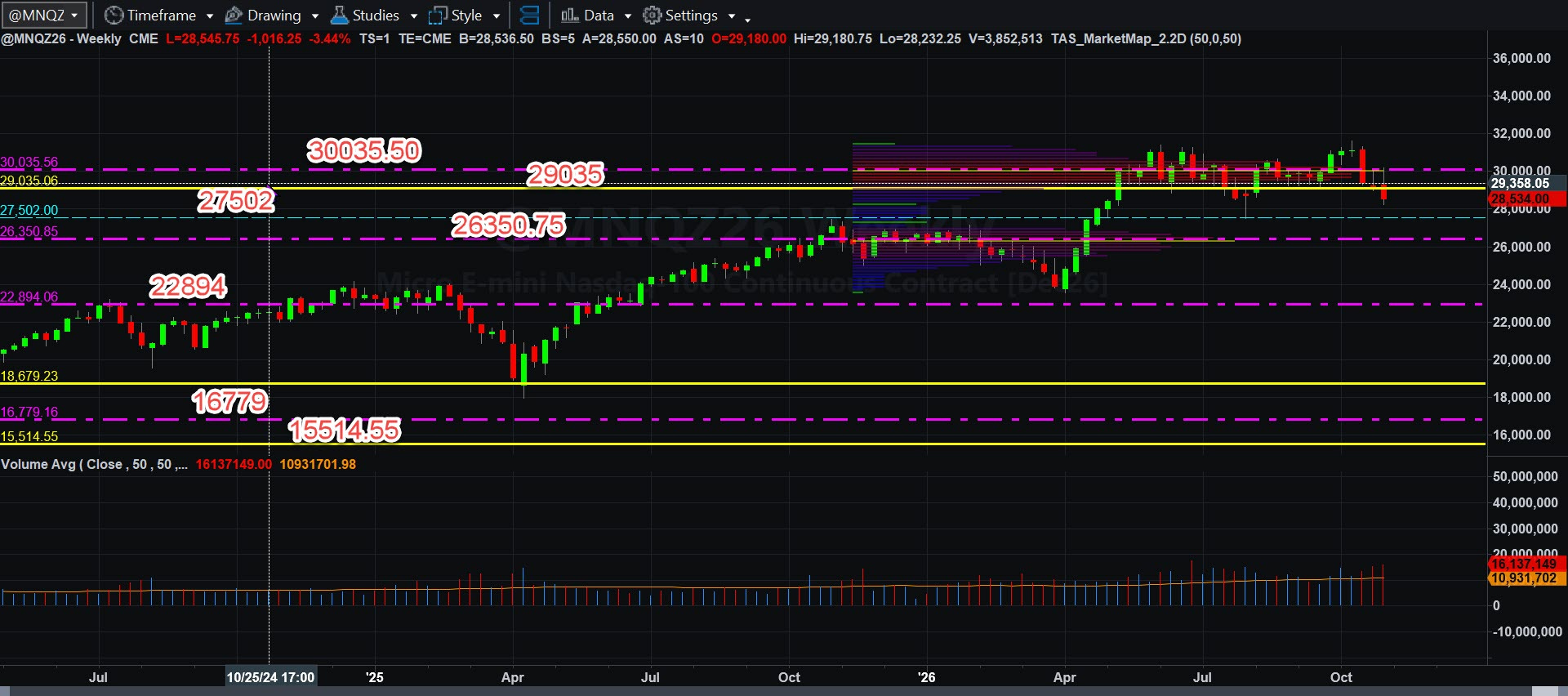
It is the end of October, so I decided to take a look at the monthly and weekly MNQZ26 charts. In this video beloe, I cover what may or may not happen beginning perhaps next week, depending on how this eventful week unfolds.
The accompanying chart analysis:
Is AI Going to Kill the 2009 to 2026 Bull Market in the QQQs (and MNQ)?
There seem to be lingering issues of AI indebtedness and basic overspending on AI data centers. Many of these AI spenders (Meta, Amazon, Oracle, OpenAI, Anthropic, SpaceX, and others) are moving forward without considering the risks that future revenues won’t cover the debt.
Chamath Palihapitiya, successful tech investor and minority owner of the Golden State Warriors expresses the situation best in this tweet. His complete comments are found in this “All-In Podcast” episode.
What has happened just this week that concerned me?
Alphabet lost $500 billion in market cap after it reported a deep drop in search volume and advertising revenue. In other words, AI has finally cut into Google’s revenues and Google simultaneously is burning capital like hay in a raging barn fire. Amazon had soft e-commerce revenues this past quarter and also had an insanely negative cash flow.
From The Motley Fool’s analysis:
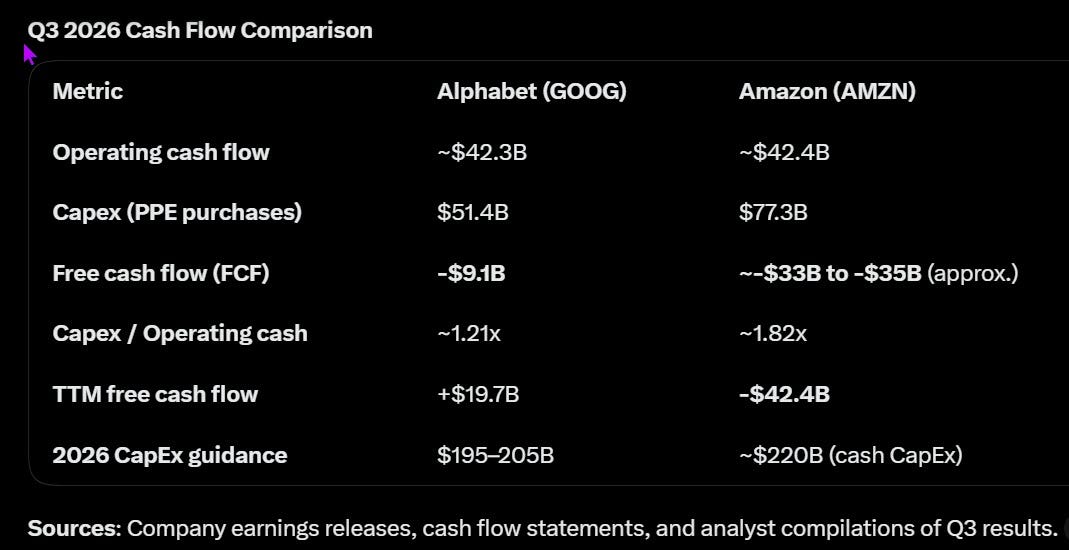
Both companies are making capital expenditures over 100% of their operating cash flows. Amazon’s free cash flow is –$42.4 billion over the trailing 12 months, and Google’s head is just above water. Their capex guidance is even more insane for all of 2026. If you believe free cash flow is necessary for sustained profitability, you might be quite concernedabout both companies, particularly if AI revenues do not show up.
If you want to see a graphic expression of potential future despair for AI token prices, all you need to do is look here for historical comparison and here for a three-year comparison by user tier is to look here for historical comparison, and here for last-three-years comparison by user tiers.
If If you think the above news is crazy, see what Anthropic’s S-1 IPO filing looks like! From the article:
Computing power is Anthropic’s largest expense item, with more than $100 billion in spending commitments with six partners over roughly a decade. Many of those contracts are non-cancelable or require payment regardless of how much capacity it uses. Its commitments involving high-profile partners include at least $110 billion with Amazon, about $114.5 billion with Google and $44.9 billion with Microsoft over seven to 10 years.
Chamath Palihapitiya, who discusses the impact of AI borrowing in the podcast linked above, thinks that as much as 30% of the Treasury market will be crowded out by private AI borrowing. That could drive up U.S. Treasury bond yields at the very time that spending restraints will have to kick in for federal government entitlement programs like Medicare and Social Security to prevent their insolvency. There is a link summary that quotes 65 sources that you can tap into for a more in-depth explanation.
To cut to the chase, the hyperscaler private debt accumulation will likely be an impediment to earnings for years to come. Consulting firm Gartner estimates that revenue shortfalls will be nearly 5 trillion dollars by 2030 (the end of the decade).
According to the Kobeissi Letter, “42 AI stocks have accounted for 58% of the S&P 500's earnings growth and 81% of CapEx and R&D growth since the start of 2024”, based on the latest data that I found today, According to the NASDAQ, up to 66% of NASDAQ-100 stock revenues come from AI related businesses. Shortfalls are likely to negatively affect earnings in the short and intermediate term (if you are considering 2030 the intermediate term). That will be a challenge for these markets going forward. A link summary of this data can be found here.
Conclusion
As the video shows, there are gaps between VWAP control points that could be filled if selling escalates. The key levels to watch on MNQZ26 are 27,502 and 26,350.75. If those levels are easily broken, then we could see a bit more selling.
We have seen this movie before, once during what I call the “Covidiocy” in 2020, and once again in 2022 and 2023 culminating with the Silicon Valley Bank crisis. The key concern here is how long and how deeply earnings will be hurt by capex. If it is deep, that is a big problem for retirees’ savings in 401(k)s, IRAs, and pensions. The U.S. midterm elections. and the U.S. 2028 elections could create another problem: a ruling elite that wants to nationalize all of these companies. Imagine AI run by people who run your U.S. Postal Service. Are you excited yet? I didn’t think so.
I cannot forecast the future; I can only glean clues from the charts as best I know how. Your investment time horizon and your ability to generate income when you need it are the important factors. You will need to work those out with a certified financial planner and other trusted financial advisors to work out for yourself. These markets are overdue for some kind of correction, which could begin Monday, or the markets could run a few more years higher. You need to figure out what works for you, keep your eyes open, and carefully manage your risks. Perhaps another time, I can discuss the topic of sequence-of-returns-risk. It was an issue from 2000 to 2009, and it could become an issue again.
That is it for this edition of the Buffalo Trader’s Writing Desk! We appreciate all the new subscribers who have joined us over the past few weeks. If you like what you read, give us a like and consider becoming a paid subscriber. If I earn more, I can do more!
Have a great week, everyone!