

In that video, (and you can see it at 8:33 into the video), you will see what my estimate of the near-term range of MNQH23 will be for the next few days to perhaps several weeks until we get clarity on Federal Reserve interest policy, consumer and producer inflation, and what the real state of our economy is from an employment, earnings, and general productivity perspective. Congressional budgeting fiscal and monetary policy will all be a part of that equation too.
We likely will see a range from 10608.50 to 14146.50 over a decently-sized timeframe, perhaps weeks to a month or more, until exogenous events or clear evidence is seen for a move to reduce rates or to raise them. I am not clairvoyant enough to know when or how, but I think I do know where volume profile and Gartley/Fibonacci patterns can take us if it does happen.
If you want to see more of the previous content on the matter of targets as time has passed, subscribe to this newsletter! It is still free.
I saw a video this morning from Thursday’s “Bloomberg The Open” broadcast in which Mohamed El-Erian finally broke the news to the “cupie-doll-talking-heads” (my kind term for them) that personal consumption expenditures (PCE), consumer inflation, in essence, is still hot and remains a roadblock to higher equity and higher bond prices. It means that the Fed may have to jack the Fed Funds rate at higher than 25 basis points to keep things at bay.
The problem with that, as I mentioned last week, was that we run the risk over time of flooding the Federal government with interest payments on debt that will swamp the entire Federal government which will ultimately lead to its collapse. The length of time it would take for that to happen shortens with every rate hike. As El-Erian is a leftist, he tends to bolster the argument that government is the answer to everything. He is likely underplaying the need to raise rates. We probably need to dig into the data a bit deeper to see how crazy things really are, which I will do now.
Let us start with the latest data from shadowstats.com for early 2023 consumer inflation:
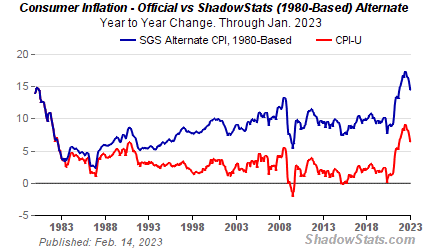
This is the updated summary of the 1980-basis calculations for consumer inflation which sits at 14.2% at the end of January 2023.
If you want to what the USDA states about food inflation, take a look at this link.
Quoting this report, “In 2023, prices are predicted to increase for other meats (4.7 percent), dairy products (7.2 percent), fats and oils (16.7 percent), processed fruits and vegetables (9.9 percent), sugar and sweets (11.5 percent), cereals and bakery products (12.8 percent), nonalcoholic beverages (9.9 percent), and other foods (8.1 percent). “ Many farm vegetables may actually DROP several percentage points this year, the damage cost-wise was done in 2022, and fertilizer prices may continue to push prices higher in the next crop season heading into 2023.
The really scary part of all this is that even though meat prices have soared double digits, a key component of all processed foods, chicken eggs are expected to explode in price once again. According to this USDA report, “ Egg prices are predicted to increase 37.8 percent in 2023, with a prediction interval of 18.3 to 62.3 percent. This wide prediction interval reflects the volatility in retail egg prices.” Eggs are used in almost every processed food imaginable. That has to be considered a factor in food inflation which is a major component of PCE.
In it’s ever-pervasive sense of nanny-statism, the Wall Street Journal encourages people to “skip breakfast” to save money. We might be better served to tell Congress and the Treasury to “stop printing money”. Eggs are the primary source of protein for most Americans, and animal protein is regarded as the greatest factor in the emergence of human intelligence over time, though you would never believe that from the actions of Congress. I could go into detail, but it’s best I do not for now in order to keep this blog post free of vulgarity.
The other thing that continues a looming threat is the continued weakness of the US Dollar now that the petrodollar has been destroyed by the Biden Administration. There are more and more agreements between Russia and China for commodity contracts that pay for commodities in local currencies, the yuan, or the ruble than there are contracts involving the U.S. Dollar. The days of the US Dollar’s reign as the world’s sole reserve currency are being numbered.
The bottom line is the same as it has been, as long as “risk-free” rates of return do reflect economic conditions in the general economy ( as Mr. El-Erian discusses) and consumer prices and consumer debt (something I discussed in last week’s weekly post) are still an issue, it will be very difficult to invest in these markets or to really provide long-range price levels. When valuations could be reasonably estimated, it could still be a reasonable task to estimate what values in the future might be, given some statistical variance. I was pretty good at that and made ample money that way.
For now, those days are gone. We seem to exist in a very central-bank-driven and government and large-corporation-manipulated equity and bond market. Those markets are as Tim Knight coined in one word, “inorganic”. These markets are a bit controlled by extrinsic factors. Commodity markets are still liquid and active, but they will be moved by changes in monetary policy which is shifting in ways not seen in a century. Perhaps later I can discuss the new agreements between Asian powers which could weaken the U.S. Dollar and limit America’s ability to borrow money without imploding the Federal government, but that will be for another time.
I can give you my best hourly, daily, weekly, and monthly estimates for price targets, but they will be technically driven by Gartley and Fibonacci pattern analysis, price momentum, volume/price momentum, and market volume profile. Perhaps if things work out, I can once again introduce neural net analysis of these patterns also. We shall see. I may not be perfect, but I am pretty damned accurate over time and always honest. It is the best I can do.
At any rate, until some major event occurs to change things, we are probably range-bound in MNQH23, in my opinion. THANK YOU FOR SUPPORTING THIS BLOG! Have a great week trading and a great week overall.

