

"Price is what you pay. Value is what you get." - Warren Buffett
"Value is what you get divided by what you have to give up to get it." Jack Welch, CEO of General Electric (that quote is particularly rich when you realize what a mess he left for this successor, Jeffrey Immelt).
"The real price of everything, what everything really costs to the man who wants to acquire it, is the toil and trouble of acquiring it." - Adam Smith
Past Episodes:
You cannot fall behind if you read them all, and here are the links to past Substack Posts:
What is Value?
In economic terms and in personal utility (usefulness) terms, what is value really? What I will do in this post is to fully describe what I think (and what most people involved in the investment and business arenas think) value is, and how it might be measured. I will look at stocks, real estate, and a small business as the primary examples. At the end of it, I will look at what the value of currency should be in the process of investing in or paying for those services so that their value can be upheld.
Just so you folks don’t wonder “where in the hell is he going with this?”, it is essential in my view that you understand why looking at the value of tangible and financial assets is critical in the understanding of how currency value relates to the measurement of any other kind of value. Things do not increase in value simply because all investments go up or MUST go up. There is a reason behind it, and there are reasons why when things go up. Assets can go up in value because of extrinsic events unrelated to the asset or the business activity.
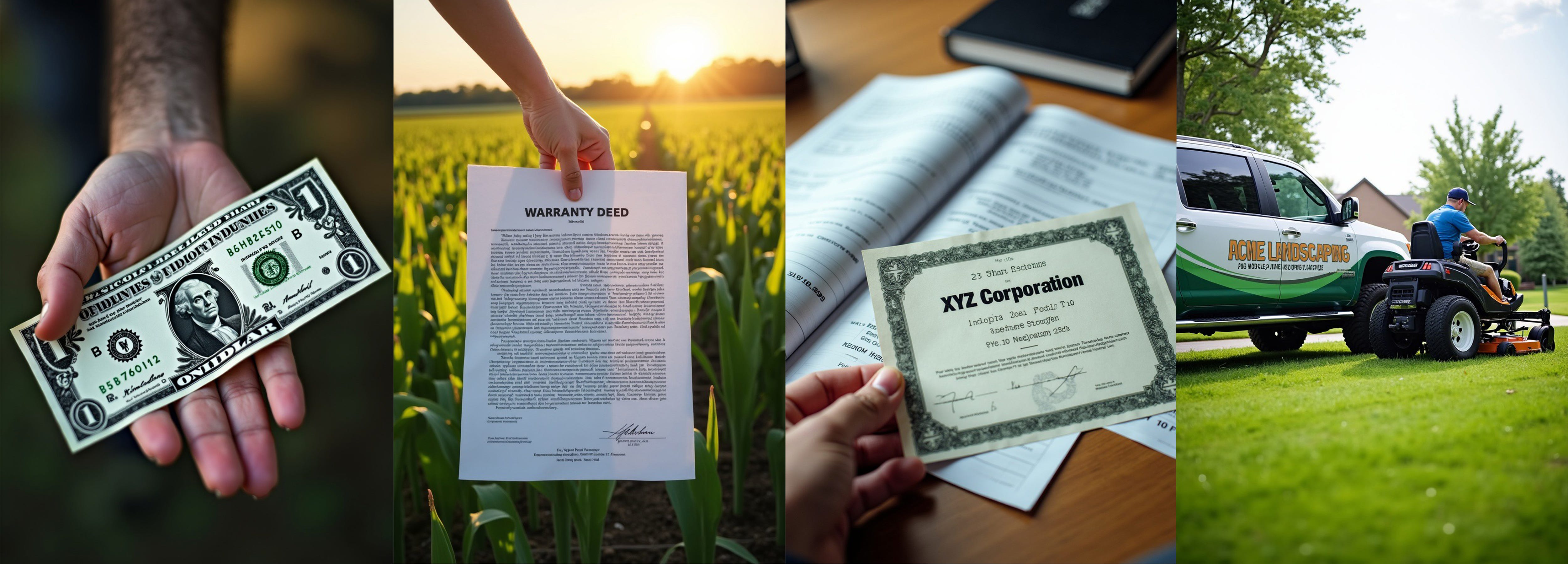
The graphic image, created by my imagination and Stable Diffusion on Civitai.com, basically provides the four examples used for value:
Equities (Stocks)
Real Estate (Farmland)
Small Business (A landscaping business)
The currency (the U.S. Dollar) will be discussed last, but it’s value is crucial in measuring the investment and operational performance of all the other assets, including the landscaping business.
What is Economic Value?
While even Austrian economists give economic value a rather subjective definition, when using one’s financial or material assets to gain an increased monetary value in the future, one has to figure out what the value of those assets employed are today compared to anything else one wants and then have a model or some kind of target in mind to measure success in getting an increased value of those assets in the future. Part of that process is estimating what the opportunity cost of doing something productive with those assets are as you might be missing a better opportunity to use them in another way.
In the context of investing and business, one is trying to figure out the best way to obtain am ample return on value invested over time, and to make sure that in future time you will have greater wealth to enjoy for future times and to reinvest to continue that activity throughout your life. That includes of course, defeating inflation as time passes. In spite of all the economic twists that can hit an economy, mises.org and rational people know that inflation is always a monetary phenomenon, caused by the handlers of currency, the government central banks.
Let’s now look at each of our examples to see how we can better extract value from an investment or a business opportunity.
Stocks (Equities)
As a teenager, I wanted to be Warren Buffett. It seems like he had the magic tough for finding cheap stocks and holding onto them. When I graduated from high school in 1973, I saw the stock market hit all time highs, but as inflation began to kick in seriously, I noticed in my freshman year at Georgia Tech that the market seemed to be continuously crushed. I began reading, even as an engineering student, the Wall Street Journal. It was then that I realized that it would be almost impossible to hold onto anything, stocks or other assets, and not be caught up in the downdraft of selling when it happened. The sad part for me at the time (and I was heavily invested in study for engineering classes, which included mathematics, which I was good at, that I could not find an alternative means to study these principles. I had been an aggressive saver in high school and in college, and I actually was asked by my father for a business loan (I kid you not), but he decided not to do it and funded things himself. Maybe in another Substack post, I will explain the irony of my education, but that is for another time. I worked as a co-operative student at Tech, meaning I worked in opposite quarters until my senior year, meaning that I would graduate a year later than I normally would.
I had an uncle who after nearly 40 years in the dry goods distribution business wanted to do something to keep him from boredom. At 65 years of age, he started a restaurant supply store because he fully understood the costs of such equipment and knew what customers wanted. Because of this understanding of cost structure and the ability to create profitable margins from them. he build what became the largest restaurant supply company in South Carolina, which he ran until his death in his mid-80s. No Amazon, no Shopify, no keyword integration, no algorithms, and no internet. He just had a keen understanding of value and know how to contact, service, and please customers. That is how he extracted FUTURE VALUE of his business. That business still runs today, via one of his nieces and one of his granddaughters.
I know I wouldn’t really understand that business, I knew that if I could fully understand value in stocks and the reason why they were fairly or undervalued, I could really make money with equities.
In 1979, after I graduated, I went to the physical internet (the public library) and I learned about the National Association of Investment Clubs (NAIC). I looked up local meeting, and found that it was highly confusing and really rather chaotic. Their literature was pretty incredible though, particularly when it came to valuing companies on a rational economic basis. It used to come through the mail.
Today it is called Better Investing, as the outfit sort of shed itself of the investment club stigma to a degree. They have tons of tools one can use to value stocks and to understand what is underneath the hood. If any of you are interested, there is another great resource to understand how to value stocks and that is the American Association of Independent Investors, AAII, and it has massive resources to help you build portfolios across many asset classes including stocks,
In the 1980s, I focused all of my time on growth stocks, as during that era, computer makers and biotech companies were really making strides even in early stages of development to make huge sums of money. Their ROIs were truly off the charts. On the other hand however, when the Resolution Trust Corporation, I suddenly figured out ways to buy newly reformed banks from the wreckage of the Savings and Loan Crisis. More on that in a moment.
When I first started serious growth investing (and this was before the rise of the web and even personal computing), I would find a Value Line ranking collection (in a local library) and look for companies that were increasing in overall rank from a middle ground (if you remember, the old 1 to 5 ranking, I would pick all the ones for which there were at 25% earnings growth and moved from a 3 to a 2 ranking). That was my initial screen to find earnings turnarounds or for younger growth companies that were coming into their highest growth periods. In late 1980, I found a self published book by Julian Robertson, the manager of the famous Tiger Investment Fund. This book literally outlined what he did to find companies with sufficient market capitalization to screen and to eventually invest in. The book I found was not this book, but an almost pamphlet-sized book. In it, Mr. Robertson described almost verbatim what I was doing to screen shocks! I guess there are no original ideas. Using that method, I found a ton of stocks that would meet at least the minimum criteria for doubling in value in a year (if everything panned out earnings-wise).
I used a primary formula, before I read Peter Lynch’s book “One Up On Wall Street”, that served as a basis for consideration. The key dynamics for a positive selection would be the formula:
(( Percentage Annual earnings growth in the forward year) + (Dividend Yield in percentage )) x 100/ Price Earnings Ratio. Just for reference, when I am discussing the price/earnings ratio, I am referring to the FORWARD price/earnings ratio.
If for some reason, the P/E were 20 and the sum of the numerator were 45 (and if it was a growth stock it predictably had NO dividend), one would expect the price to reach 2.25 times its current value in the coming year.
In the growth names I pursued, more often than not it worked. You still had to read up on all the annual reports, and back then NAIC would send you literally any annual report you wanted. I sometimes received 15 lb. boxes of those things, and I would sort through them to find what I wanted and then tossed the rest.
I made a ton of money, not just from my job as a field engineer, but through careful investing. It allowed me to pay for my graduate education. The sad part is, the graduate education did not, as it turned out, allow me to pursue a career in finance, as I was promised something that never occurred. Had I gone to Duke University (and I was serious about it), I probably could have. I sold nearly all of my portfolio at the time I went to graduate school, because I might not have had the time to follow it. I was invested in two drug infusion equipment companies. Had I held onto them, I would have been incredibly well-heeled in cash. It was not to be. I still held two funds, one of which was Fidelity Magellan Fund, which was run by Peter Lynch.
I used CompuServe at the time to gather earnings data out of their databases. In late 1986, I purchased a copy of MetaStock. I was beginning to rebuild another portfolio, but I was not as well aware of what was going on with margin interest, large program trades and all the portfolio insurance issues that were prevalent into 1987. Volatility was increasing greatly. I was somewhat oblivious to it. I did, however, read a book by Norman Fosback, “Stock Market Logic” . In that book, Fosback had a methodology of comparing economic growth to moves in the prime interest rate during a business cycle. In early 1987, he was sending out warnings in his “Mutual Fund Forecaster” about a climax in potential strong dollar policies of the Reagan administration and stock valuations, which might ultimately lead to a panic. He continued to hammer home that point as I decided to simply hold onto what I had as I rebuilt a stock portfolio. He believed based on his own quantitative analysis, that the market had peaked in August of that year, and was only waiting to take a dive. There were only three people I knew of at the time who were seeing this. One of course was Norman Fosback, the other two were Paul Tudor Jones, and, as I found out later, one of my mentors, Larry Pesavento. The latter two gentleman made fortunes shorting those markets. I remember calling Fidelity Investments at the close of business on October 19, 1987 to find out where Magellan had closed. “You don’t really want to know, do you?” is what the representative said on the other end.
I had taken a very hard hit indeed. It made me want to study technical analysis much more after that, and I pursued it with great enthusiasm. That is when I met both Larry Pesavento and another person who also became a dear friend, Ed Dobson of Trader’s Press. That is where I learned technical analysis. I purchased countless books and built a library of them.
The real reason I cared so much about value is the fact that history favors holding value as long and earnings remain strong and grow relatively quickly. That is one of the easiest ways to grow wealth.
What I did, using Grok and several websites including the multpli.com website is put together an average annual 10-year bond yield (for consistent comparison only because the old bench mark of a 30-year bond was casually tossed by the Fed back in 2009), to show you have Shiller P/E (which is inflation adjusted) compared to the 10-year bond yield over time.
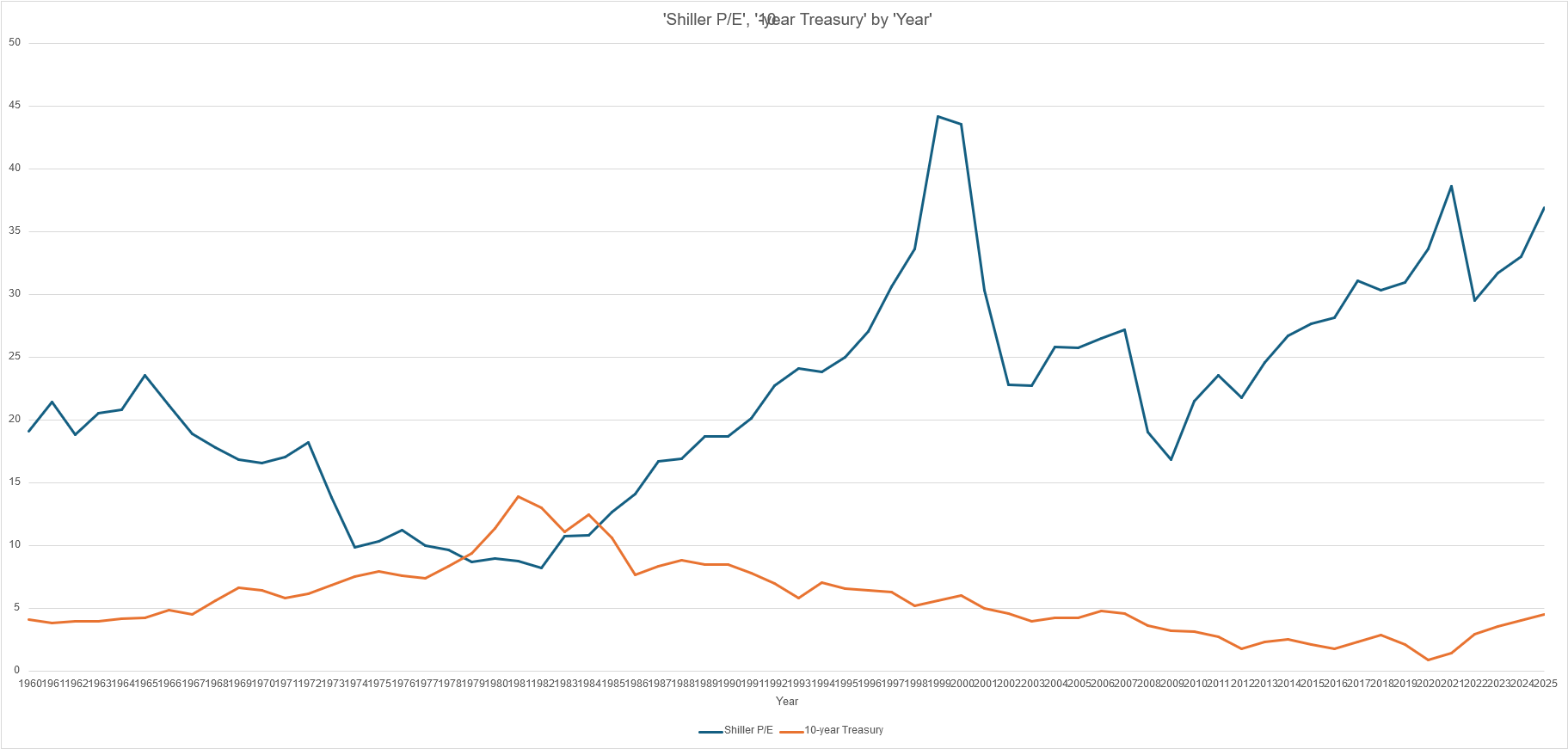
When I began investing in individual stocks in the 1980s, interest rates were insanely high, and the Shiller P/E was under 10 at the beginning. My goal was to find stocks with consistent earnings results growing at 25% per annum or greater and with NO DEBT. The goal was to look at a company with high growth performance and very low enterprise value. My goal was to double my money every year, but to do so by finding clean balance sheets and high growth. If I were using that Peter Lynch model, I would be looking for 25% growth +0 dividend (as I would want all cash to be churned back into company operations) and a P/E ratio of say 10 to 12. In the period of 1979 to 1982, it was literally child’s play, if you did your research, to find companies like that. The U.S. stock market was so beaten down that you could find anything from banks to technology companies that had those kinds of numbers associated with them. When money market rates were soaring to 20% and above, stocks were buried. I had a great deal of success in investing this way. As the 1980s passed on into the 1990s, it became a bit more difficult, as those general valuations continued to rise. In the original version of Benjamin Graham’s “The Intelligent Investor”, he recommended looking for stocks that had price earnings ratios around 6. SIX, in the environment of the 1990s? There was zero relevance to that notion.
As time went on, and I was working in North Carolina, I would spend my nights looking for these stocks and finding them through CompuServe and at a local library. In 1993, I decided to bail from my job in North Carolina, I helped an entrepreneur start an institutional brokerage firm. By the time I arrived in Atlanta, I had already studied for my Series 7 and 63 exams in North Carolina, and passed them in a week after getting there. That upset the general partner, who wanted me to be starving. Instead, I set up an nice apartment in Chamblee, GA to live, which I really did not do a lot of there. I was calling international markets at 0200 EST each morning, and working in that office about 20 hours a day on market days, and more on the weekends after. The knowledge I gained in North Carolina served me well. After the Gulf War, many Middle Eastern banks and hedge funds had shut down their operations for a time and came back into business in 1993. I was there and picked up some pretty impressive clients there and in Europe. The point is, my penchant for finding value and growth in equities was exactly what institutional funds overseas were looking for.
I left that firm for good reasons in 1995 (for reasons I will not discuss here but they are quite interesting to say the least) and decided just to go on my own alone. I had amassed stocks in energy, in technology (though not necessarily Apple or Dell, and a broad number of consumer goods stocks. When the Thai Bot Crisis hit, and when Long Term Capital Management Collapsed, I began to worry that another route like the one I experienced in 1987 was coming, and that I needed to protect myself by picking places to exit and piling up cash. In 1999, as the Shiller P/E was rising above 40, I decided to cut back my positions and wait out what might happen next. In January of 2000, I avoided what came. I never went back fully into the market until late 2003. I could explain the pattern analysis I learned from Larry Pesavento to make that decision, but that can come at another time.
Remember what price/earnings means. If a ratio is 40, it will take 40 years for you to earn your money back for what you invested in that stock. It is seldom if ever that a company can do that, even when growth is at 25% a year. If your average portfolio is supposedly returning 10% a year (which basically doubles your money in 10 years) is sitting on a P/E of 40, do you think that portfolio has a fairly high degree of portfolio risks? I would say YES to that question. That is why I departed about 90% of mine in 1999.
There was one great piece of advice given my Stan Weinstein, who wrote this book, about anyone who has doubled one’s money in a particular stock. He advised that one should sell half of it, hold onto the other half and invest the other half in another stock that meets your investment criteria for purchase. In that way, you are now “playing with the house’s money” in his own words. If more people did that, their portfolios could survive almost anything.
I guess what I am trying to relate to you as that even using technical analysis to decide when to leave, the overriding factor was a decision not to hold assets that were overvalued. My criteria was to hold something that I could double my money in 2 years as long as I knew the company could deliver on those efforts, as the performance in REAL EARNINGS could produce the rise in price. If it did not have those characteristics.
There have to be real economic underpinnings to the price of any asset that I own. I do that so that I do not have to worry that I stayed too long in one place if a market turns against me.
I have more to say about high price/earnings ratio stocks, but I will do that in a post unrelated to this series, but it will be very detailed in nature.
The other point I want to follow with on this asset is the cost of acquisition and sale of these assets. In the 1950s, the commissions required to pay for stocks were astronomical and often constituted quite a burden on an investment in them. Over time, regulations were put into place to reduce those costs, making them easier for the general public to purchase. Why am I mentioning that? Because it is the exact opposite of what is happening with Bitcoin, something I will cover in Part 4.
This part of the post was somewhat of a ramble, but I wanted to make the point of what real value means in any investment you have. Markets determine that, but extrinsic factors like money supply and lack of discernable investment hurdle rates also factor into it. Investments are not pre-destined to go up forever, despite what current generations may think. The coming decades will likely prove that, but I will get deeper into this topic at another time. Let’s move on to a much briefer discussion of real estate.
Real Estate
I have invested in real estate, it turns out, for a very long time. I began my investing in REITs in the 1980s, but became a bit reticent to holding them as the savings and loan crisis hit in the USA. It was not until 1999, when I happened to inherit land with my brother that I decided to truly get serious about land investing and eventually into hard money lending on land that I true began to value land as a separate asset.
I invested a lot of hours into understanding what comparable prices were on raw land and on rehab properties as the financial crisis of 2009 hit also. I was and still am highly skeptical of the stock market after prime rates of interest were cut to zero, meaning there was no discernable hurdle rate based on the time value of money (which was in effect, after inflation, at or BELOW zero, by Federal Reserve dictate). In 2009, I began to look into local real estate markets. I had excellent information on comparable property values based on existing market prices and the value of repairs required to rehab the properties to market values.
I would not accept anything valued above at 70% of loan to market value ratios to fund for rehab, as it would not allow me leverage to make a profit after repair expenses. The goal was always to earn, at a minimum 20% annualized return on the investment. I worked with partners whom I would fund the rehab work on a property, and in the end after typically 6 months, I would receive a return equal to that annualized return.
That was a simple task in 2009 until about 2013 because asset values had been degraded during the mortgage crisis of 2007 and 2008. The reason for that was that mortgages were offered to people who could not, in the end, afford to pay them. The whole mess with credit default swaps destroyed the mortgage business and the values of homes across the United States.
Because I chose carefully verified market prices on real assets for a defined period, I never lost an nickel and in fact made good money as a real estate hard money lender. What became difficult in 2020 and beyond was the values had increased rather quickly, and there were fewer high-value projects in the market that could be profited from.
I knew when to exit that market because the net returns were no longer really there. Could they have been found? The answer is yes, but the time it would take in order to find them it would eat up a ton of hours and would require an extensive amount of research to find them. That was not worth it to me.
My investment decisions were not based on an unaltering faith that an asset would always go up in price. It was based on market values that I could trust and prices that I could make money with. As the old saw goes, I made my money when I purchased the investment and NOT when I sold it.
In terms of raw land sales, I also purchased a large property (37 acres) that I had planned at one point to build on in retirement in 2009. The same thing happened in this situation. A retired executive who had purchased rural property in a hilly quasi-mountainous property in my part of South Carolina came to me with an offer priced at basically 50% of current market rates, which were already depressed. The key factor of this land were: 1) direct abutment to a national forest (which meant there would be privacy on three sides and 2) it had about 7 acres at the top of a crest, completely buildable with solid soil. At that location, you could see views from three states (Georgia, South Carolina, and North Carolina). Because I could get a homestead exemption on the property, I could pay basically a steak dinner a year for property taxes.
I held onto that property until 2021, when a neighbor argument about the need for a 2 mile long privacy fence came about. ATV’ers had begun riding down the center of my property and defiling ( literally destroying) portions of a creek that ran through the center of that property and threatened to damage gravesites of the original owners of that property (from the 1770s). One of the covenants of that property was that those graves were to be protected. One of the neighbors, who I can to know pretty well, was doing that caretaking.
People tell you that you can never sell raw land as it is just too illiquid. That is simply not true. Firstly, I purchased that property knowing that its qualities were rare and that the neighbors cared as much about that property as I did. I also knew that the buildable qualities of that property would make it easy to snap up if the market knew about it. The only thing I needed to do was two things. 1) I needed to find someone who marketed properties to retirees who wanted to be apart from residential neighborhoods (and other neighbors in terms of line of sight) and 2) the buyer would want to establish privacy. That meant that they would gladly pay for a privacy fence.
That privacy fence became a STIPULATION to OWNERSHIP of the property. It was written into the sales agreement. How long did it take me to sell it (owing to the fact that I was working with an agent who had the talent to market to the right customer)? 9 days. That’s it, only 9 DAYS.
The reason I could do that is that I understood the property and had an exit plan in mind. Again, a real physical asset with qualities that others could appreciate and equally value and the right marketing strategy, and I obtained a nice profit for it after 12 years. There was a reason to enter and a reason to exit (I did not want to invest in a fence for a property I was not ready to build on) and marketing strategy with little friction to take the profit. Volatility of pricing as not an issue either because market values were easy to establish and were relatively stable for that local market.
If you understand your market, you can extract value in ANY MARKET.
Now let’s cover the last topic of a business (say a landscaping business). This will be the least detailed, but will get the point across about offering services of value an minimizing resources required to do the job.
Small Business ( A Landscaping Business )
A small business often offers a valued service at a market price and must deliver that valued service at a profit.
What is required to do that. 1) An understanding of market prices. Around here, it typically runs on a full service price of about $100 dollars an hour. (That is why I still mow my own grass). The expense it takes for me to maintain my equipment is about 3 hours a year, and I get a chance to get out of my office for the 45 or so minutes, twice a week to mow the lawn from late February to mid-October (that is 34 and a half weeks times 2 and .75). That is 51.75 hours at 100 dollars an hour or $5175. I will gladly pocket that annually, get my vitamin D in summer, and mow my own lawn. I need only about 25 gallons of gas a year, so that runs basically $3.40/gallon x 25 or $85. The riding lawn mower has been amortized to about $163 a year (including the service).
Some people don’t want to do that and they pay the price. If you can mow 50 lawns a week, you can pick up 50 x 0.75 X 100 =$3,750 a week. That would be considered a fair price based on market values determined by where you live and what neighborhood you service. What you would have to do from there is to figure your costs of repairs, equipment, and fuel (and your labor included) to make a profit. There are also some hiring costs, but I have seen some local landscapers as husband and wife teams that bring along family members to work when they are not in school, and they work in the summer.
I am not trying to teach landscaping as a business, but my point is, once you understand the value of a service, you can back out, based on experience and experimentation, the costs of providing that service to obtain a profit. There are real assets (equipment, fuel, labor) being used to create a valued service (lawncare). I am not even going to go into other services like hedge trimming to expand on the concept. You understand the basics of creating value for a customer or a consumer.
What does Currency Have To Do With All Of This?
What makes really understanding of the value of an investment difficult? It is the value of the currency and the money supply, represented here by M2 via the Federal Reserve:
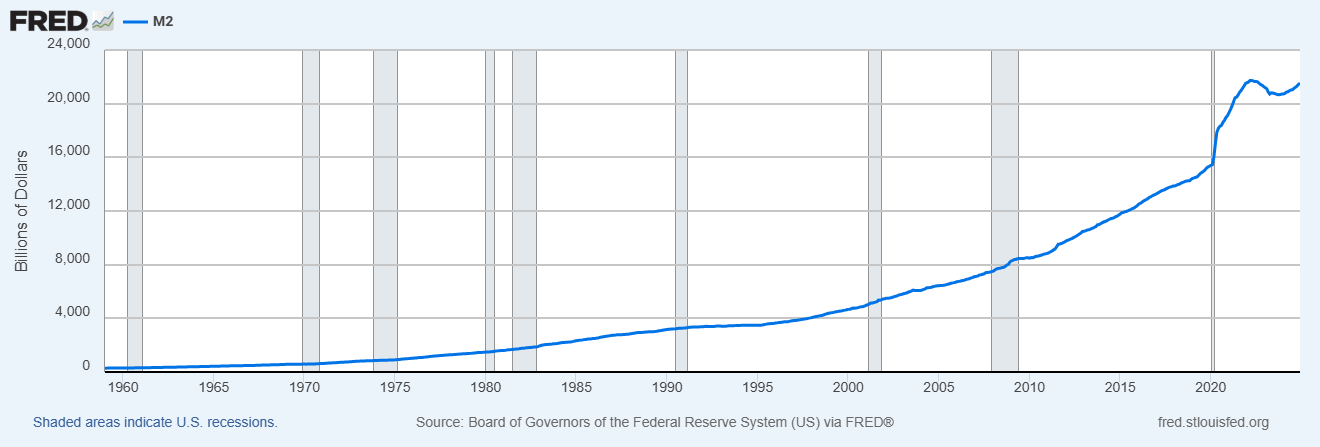
As you can see from 1971, the end of the gold standard for the US Dollar and today, money supply has expanded astronomically. Since 2009, it has completely gone off the charts, helped by expanded government spending to bail out banks during the Great Recession, on entitlements, healthcare, and other kinds of social spending unbacked by revenues largely. After 2020, the printed money (not backed by government revenues) was used to pay for Covid-19 lockdowns and benefits for people who were forced not to work by the lockdowns. When printing money without backing, the government dilutes the value of the dollar when it prints more to spend.
What is the value of the dollar, well, since it is no longer used universally to pay for commodities like oil, one would have to consider the U.S. Dollar worthless, save for any strength in the economy it gains from resources or for exports. The problem with that is we run a trade deficit. The only real reason now that the U.S. Dollar has any ghost of a hint of value is that it is considered the strategic reserve currency used for payments worldwide.
Now that other countries are paying for oil in their own currencies, the value of U.S. debt is being questioned, as Japan and China (the largest holder of U.S. Debt) are selling our bonds, the U.S. government must by them in order to keep interest expense down. Now that special reserves for that purpose have wound down, there is no facility to continue to do that. If the Fed cuts rates, there is fear that the risk of default on bonds increases, and interest rates on bonds RISE, and the value of U.S. Treasury debt falls.
Since banks hold that debt as collateral against loans banks make, that makes banks less financially stable. That could over time lead to runs on bank deposits, and loss of faith in our banking system. Price inflation begins to rise and the ability to earn money in the economy becomes more difficult as resource prices rise. It is ruinous doom loop of price increases and revenue shortfalls. When investment hurdle rates compared to money that has zero time value after inflation, you have no basis for which to know the return. Every investment, when the investment hurdle rate of zero, has potentially infinite value at the margin (if you think in terms of rate of change). THAT KIND OF RETURN DOES NOT EXIST IN THE RATIONAL WORLD, PERIOD!
If those hurdle rates remain low, when a business fails, the value of that investment can quickly crash to ZERO also.
How Can Bitcoin Solve Any Of This?
What we need to discuss next is how cryptocurrency, specifically Bitcoin is supposed to solve this. Can it solve it or is it just another canard run by fraudulent actors? The answer is far more complex than any simple answer developed by Bitcoin “true believers”. We will start that discussion next time. Stay tuned!
Thanks again for everyone’s patience as I knock this series out. I have a ton of simultaneous projects going on, and it is tough to parse the time out to get them done. I will see it through however, and I think you will like the result. Thanks once again for supporting the Buffalo Trader’s Writing Desk!
No wonder the economy is in terrible shambles. Wonderful article David, I learned a lot and look forward to you next installment about Bitcoin which we’ve been reluctant to invest.