

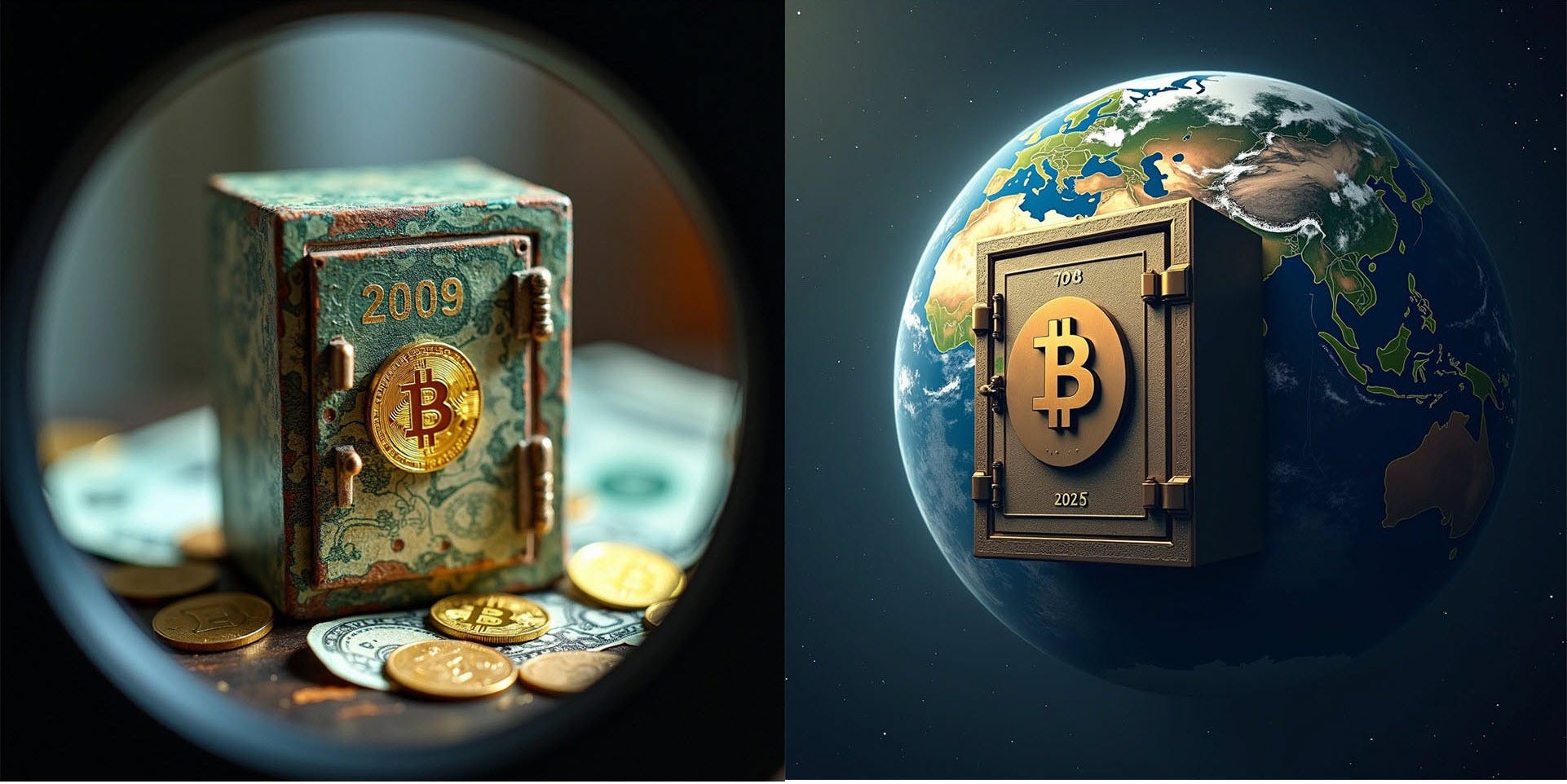
The images above were meant to convey how a tiny concept in 2009 represented by a tiny safe supposedly seen under microscope (though Civitai couldn’t quite grasp the concept totally) to the massive phenomenon, seemingly dominating the globe. Bitcoin moved from theory to awkward application to rabid adoption hysteria over a libertarian concept of value transfer. Bitcoin is is a little of everything. That is its biggest positive aspect, and also its biggest problem in the financial world at the moment.
Past Episodes
Thou shalt never be left behind: Part I , Part 2, Part 3 (but if you want, I could drop you off in Cleveland, but we’d have to negotiate the price, and the weather will have to warm up a lot before I go :D ).
Quotes for this post:
“Everything to do with cryptocurrencies and blockchains is the domain of fast-talking conmen. If anyone tries to sell you on either, kick them in the nuts and run.” ― David Gerard, Attack of the 50 Foot Blockchain: Bitcoin, Blockchain, Ethereum & Smart Contracts
“This is a historical lesson of immense significance, and should be kept in mind by anyone who thinks his refusal of Bitcoin means he doesn't have to deal with it. History shows it is not possible to insulate yourself from the consequences of others holding money that is harder than yours.” ― Saifedean Ammous, The Bitcoin Standard: The Decentralized Alternative to Central Banking
What in the Hell Is Bitcoin?
For most people, I would imagine, they might have the same reaction to Bitcoin as two rubes at a bus station in muffin (MFN) country. MFN is an acronym that starts with “middle’a”. I will allow you to use your imagination to figure the rest. The “F” rhymes with a gerund that describes what 18-wheeled vehicles do on most American interstate highways and state defense roadways. You can try the name game with that gerund.
I will do my best to produce a scaled-down version of Bitcoin operation to make it easier to understand.
I guess the first question I have is have any of you, even the true believers out there, actually read or consumed in audio form the original Bitcoin paper? If you have not, you can read it right here. It is NOT massive, it is basically a 9-page typed document that reads like a senior high-school nerd’s paper from an AP computer science class. I actually downloaded an audio format of it so I could “read” it at the gym while working out.
Bitcoin is described as an electronic ledger system designed to transfer money from one node to another in a network without the massive fees that banks and other third party holders would charge for handling the process. In terms of payment systems, it would eliminate the charges you might have for wiring money point to point, like Zelle or via ACH payment. It eliminates any central bank handling of a transaction as long as funds transfer without error from point to point.
I will now get to the point where I will piss off a great number of readers here, but I think it is worth discussing, because many people fear that their “lack of knowledge” is too great not to acknowledge the “wonder of this concept”. I think the true believers may have no concept of financial or asset risk (unless, perhaps they become “Bitcoin whales”, or large holders of Bitcoin. Those who are skeptics have no idea about how this ledger and “cryptocurrency” for better or ill could be adopted and perhaps leave them behind. In fact, it could happen and screw over both groups royally, depending on how cryptocurrency rolls out. More about that later in this series.
How Did The Original Bitcoin Really Work?
In its original format, the answer is more complicated that one might want to portray.
The way the original Bitcoin worked was that tokens were created whenever a transmission of funds were sent between a buyer and seller’s nodes. Those transactions become part of a blockchain that contains all the transactions inside a given block.
This discussion will get a bit wonky, but it is worth it.
From the paper, the process of dealing with individual transactions works like this:
“A block is defined as follows:
Collection of Transactions: A block is a collection of transactions that are verified and bundled together by miners.
Structure: Each block contains:
A list of transactions.
A reference to the previous block (via the previous block's hash), creating a chain of blocks or "blockchain."
A timestamp.
A nonce (number used once) for the proof of work.
The hash of the block itself.
Proof-of-Work: Each block requires miners to find a hash that meets a certain difficulty criteria, which is adjusted to maintain a roughly 10-minute interval between blocks. This process is known as proof-of-work.
Immutable Record: Once a block is added to the blockchain, altering any information within it would require re-mining not just that block but all subsequent blocks as well, which is computationally infeasible, thus ensuring the integrity of the transaction history.”
"The steps to run the network are as follows:
New transactions are broadcast to all nodes.
Each node collects new transactions into a block.
Each node works on finding a difficult proof-of-work for its block.
When a node finds a proof-of-work, it broadcasts the block to all nodes.
Nodes accept the block only if all transactions in it are valid and not already spent.
Nodes express their acceptance of the block by working on creating the next block in the chain, using the hash of the accepted block as the previous hash."
The hash is basically a difficult mathematical equation that needs to be solved before any block can be accepted. As time moves forward, those hashes get harder to solve, and that is part of the reason that there is a limit of Bitcoins that can be mined.
Now that we have established that something of value (a payment) has crossed a node between buyer and seller seamlessly, we have to figure out how to pay for this process. It take electricity and a computer to do the calculations required to create the transaction blocks. How do the miners get paid for it, and how does each party, buyer and seller pay for the service? After all the service is NOT free and can never BE free because of the work done to secure the transaction between nodes.
How Do Miners Get Paid?
(To try to keep this simple, I will not get deep into the woods now about block reward, though I may produce an appendix of some sort at the end of it all so you can read about it yourself. I am going to do my best to focus on the key concepts. )
This is the basic format for payment:
Bitcoin miners are compensated in two primary ways for their efforts in securing the Bitcoin network and processing transactions:
Block Reward:
Newly Minted Bitcoins: When a miner successfully adds a new block of transactions to the blockchain, they are awarded a certain number of bitcoins. This reward is programmed to halve approximately every four years or every 210,000 blocks. Initially, this reward was 50 BTC per block; it is currently 6.25 BTC after the last halving in May 2020. The most recent halving reduced this to 3.125 BTC. This block reward is the primary incentive for miners and represents new Bitcoins entering circulation, contributing to the total supply cap of 21 million Bitcoins.
(That part is very important, and I will dig into that later).
Transaction Fees:
Fees from Transactions: Each transaction included in a block can include a fee paid by the sender or recipient of the Bitcoins. These fees are collected by the miner who successfully mines the block that includes these transactions. Transaction fees are meant to provide additional incentives for miners, especially as the block reward diminishes over time. The fee amount can vary based on network congestion, transaction size, and the urgency with which a transaction needs to be processed (where users might pay higher fees for faster confirmation).
What does the pay include?
Bitcoin: The primary form of payment is in Bitcoins, both from the block reward and transaction fees. This payment is directly added to the miner's Bitcoin address upon successful mining.
No Direct Cash: Miners do not receive payments in traditional currency like USD or EUR directly from the Bitcoin network. They must convert their Bitcoin earnings into other currencies if they wish to do so through exchanges or other financial services.
Volatility Consideration: The value of the payment in fiat terms can fluctuate significantly due to Bitcoin’s price volatility. This means that while the number of Bitcoins a miner earns might be constant for each block, the real-world value of that reward can vary greatly from day to day.
Operational Costs: While not part of the direct payment, miners must consider the costs of electricity, hardware maintenance, and other expenses related to mining. These costs can significantly affect the profitability of mining operations, especially as mining difficulty increases over time, necessitating more powerful (and costly) equipment. The difficulty of the hash calculations is necessary to limit the number of coins issued over time as well as the total amount of 21,000,000.
The combination of block rewards and transaction fees ensures that miners have an economic incentive to continue validating transactions and maintaining the integrity of the Bitcoin network. However, as block rewards decrease with each halving event, transaction fees are expected to become a more significant part of miner compensation, potentially leading to adjustments in how the network handles transaction economics. That is a big deal as well, and one of the reasons that in another installment of the series we will discuss the reason things “got forked” in 2017. That is where a key controversy took place.
Is Bitcoin Really A Currency?
In its original form as described in the original Bitcoin paper, Bitcoin was considered to be both money and a means of transferring funds at minimal cost, depending on how one defines "money." Here's a breakdown:
Money Characteristics:
Medium of Exchange: Bitcoin was designed to facilitate transactions directly between individuals without the need for intermediaries like banks. The whitepaper describes a system where transactions are verified by network nodes and recorded in a public ledger (blockchain). This directly aligns with the function of money as a medium of exchange.
Store of Value: The paper outlines Bitcoin with a fixed supply cap of 21 million coins, which inherently introduces a scarcity component, potentially making it a store of value. However, this aspect was more speculative at the inception since Bitcoin's value was not yet established in the market. The real problem with that is that it has no specie backing whatsoever, and as such, on a strict definition basis, has no intrinsic value. Before you slam the screen and get angry at me, I will come back and address that later in this post. Be patient.
Unit of Account: In theory, Bitcoin could serve as a unit of account, where prices of goods or services could be denominated in Bitcoin. However, in the whitepaper, this aspect is less emphasized since the primary focus was on the transfer mechanism. There is a bit of hitch in that concept too, but that can be dealt with.
Means of Transferring Funds at Minimal Cost:
Low Transaction Fees: One of the key innovations was reducing transaction costs by eliminating the need for intermediaries. The system uses proof of work to validate transactions, which ideally should maintain low costs, though in practice, this has varied with network congestion.
Peer-to-Peer Network: The whitepaper describes a network where transactions are broadcasted directly among users, which was revolutionary for reducing costs and increasing accessibility.
From Satoshi's perspective, Bitcoin was directly intended to be a form of electronic cash, suggesting it was meant to be used as money. Here's the relevant quote from the Bitcoin whitepaper:
"A purely peer-to-peer version of electronic cash would allow online payments to be sent directly from one party to another without going through a financial institution."
There were no third parties intended to be involved in the transactions. No transaction touched a banks hands or was put into a custodian account for an intermediary to handle. Disintermediation (other than at the ends of the nodes) for each party, was the name of the game for Bitcoin.
Decentralization and Trust: Bitcoin's design aims to solve the problem of "double spending" without needing a trusted third party, which is crucial for the concept of money in a digital context.
Therefore, in its original form, Bitcoin was indeed envisioned as money with the added benefit of being an efficient, low-cost means of transferring value. However, whether it fully functioned as money in all aspects (like stability, widespread acceptance, etc.) depended on its adoption and the market's perception over time. Acceptance is a key concept, because early on, the original Bitcoin was not really widely accepted, even though consistent attempts were made to make it so.
But let’s get down to the real nitty-gritty of the question. Is it REALLY A CURRENCY? Let’s consider each key point again:
Is it a medium of exchange? : As mentioned earlier, Bitcoin was designed to facilitate transactions directly between individuals without the need for intermediaries like banks or other fiduciary or custodial institutions. The transactions are on a public ledger. That is what a medium of exchange IS. So that part of the answer is yes, a resounding YES.
Is it a unit of account?: Bitcoin, even in the beginning, could serve as a unit of account, where prices of goods or services could be denominated in Bitcoin. Though the original purpose of bitcoin was nearly frictionless transfer of funds across nodes using the blockchain, it was not actually conceived to really be a unit of account. Since it could theoretically, then the answer to this question is YES.
Is it store of value?: In its original format, this is a bit of a sticky wicket for Bitcoin. The fees for transacting transfer payments on Bitcoin were meant to be small, as they were used to reduce transaction costs. Even though miners were rewarded in fees and in Bitcoin, over time as coins were mined, miners were supposed to survive on the small fees because of the millions upon millions of transactions they would process over time. In the very beginning, Bitcoin had NO INTRINSIC VALUE, period. That was how it was supposed to work in theory.
However, as time went on, transactions were not always frictionless. The first recorded real-world transaction was for pizza, and Laszlo Hanyecz paid 10,000 BTC for a couple of pizzas. In that process, BTC would have been valued at 0.0004 U.S. Dollars, (and if you are precise, it would have been that number LESS the fees associated with the computational transaction. That was one of the earliest real world indications of what BTC would be. It occurred on May 17, 2010 and cleared on the books at the pizza joint on May 22, 2010, which is now referred to as Bitcoin Pizza Day!
The original concept of Bitcoin was to be a “frictionless” transaction that turned money into a pizza. A Bitcoin was to be ( as would make sense logically) to be a rather fractional transfer of wealth (in fiat currency) to a seller without banking interference. To that extent, did it really store value?
If you are honest, the answer is really no, as the fees for the transaction could have been a fraction of THAT Bitcoin. The miner was supposed to make money by transacting BILLIONS of transactions over time and not on collecting coins of massive value. So for Bitcoin to really have intrinsic value under that set of rules, it is pretty much as it was in the beginning. It had NO INTRINSIC VALUE basically. It would never be a store of value, particularly if fees for doing the transaction rose.
So in its original format, BITCOIN WAS NOT A STORE OF VALUE!
If that is the case, then the answer for the original Bitcoin would be NO as to being a legitimate stable currency.
Then What The Hell Happened To Bitcoin?
Just like every other fiat currency in the world, exchanges were built to allow Bitcoin to be traded against other currencies. In other words, rank speculation became the norm in Bitcoin! Bitcoin was allowed to float against other currencies, and exchanges like New Liberty Standard and Mt. Gox began to spring up, and the speculative fever went crazy after that.
In October of 2009, New Liberty Exchange had a dollar equal to 1309.03 BTC. That meant a Bitcoin was worth $0.0007639. And some portion of that over that amount (initially 50 BTC) was paid per block, so the fees were not massive. In theory, as the transactions grew into the millions, miners could be self-sustaining and pay themselves reasonably for keeping the encrypted network running. In July 2010, Mt. Gox priced Bitcoin at $0.05 cents per Bitcoin.
As time went on, and Bitcoin became adopted by more people, businesses, and institutions, the speculation continued to be crazy heading into 2014 as Bitcoin surpassed $1000 a coin. Into that time, the Silk Road controversy hit and there was chaos. Eventually it led to a split of Bitcoin Cash (BCH) from Bitcoin (BTC) in 2017. That was when the fun really began, when futures markets began to adopt contracts for Bitcoin.
I am going to leave it here for now, because not only is rank speculation a story of Bitcoin, but the whole controversy over block size has set the tone of even wilder price speculation and “adaptation” of Bitcoin.
What two phrases are not found in the original Bitcoin paper? “Digital gold” or “world money” are the answers. Bitcoin was never intended to be a store of wealth or an “investment”. Yet, here we are. I will address these issues in the next post and throw in a ton of statistics you may or may not know about.
I will also try to add my personal story to the one of Roger Ver. I nearly did what he did a long time ago, but I decided not to. Do I regret it? Not really. I will cover that in more detail next time.
Thank you to the new subscribers to this Substack and thank you for supporting The Buffalo Trader’s Writing Desk! I will return soon with another installment of “Of Bullshit And Bitcoin”!
Very helpful. Thanks!
Lol I’m sorry but you do not understand economics if you think “intrinsic value” is real. Absolutely nothing has intrinsic value and all value is subjective. Things have value because humans value them.
Gold would have no value in electronics nor in jewelry if humans did not value electronics and jewelry.
Not to mention half of all golds value is derived from its monetary value.
It is naive to assume that what humans value today, they will still value tomorrow.
Your attempt to discredit Bitcoin was valiant. You know more than the uninformed commoner about it, but still have completely missed the mark.
To all readers. Do your own research and don’t trust what I say or what this guy says. Verify it for yourself and come to your own conclusions. You have to put in the work and set aside your ego.