

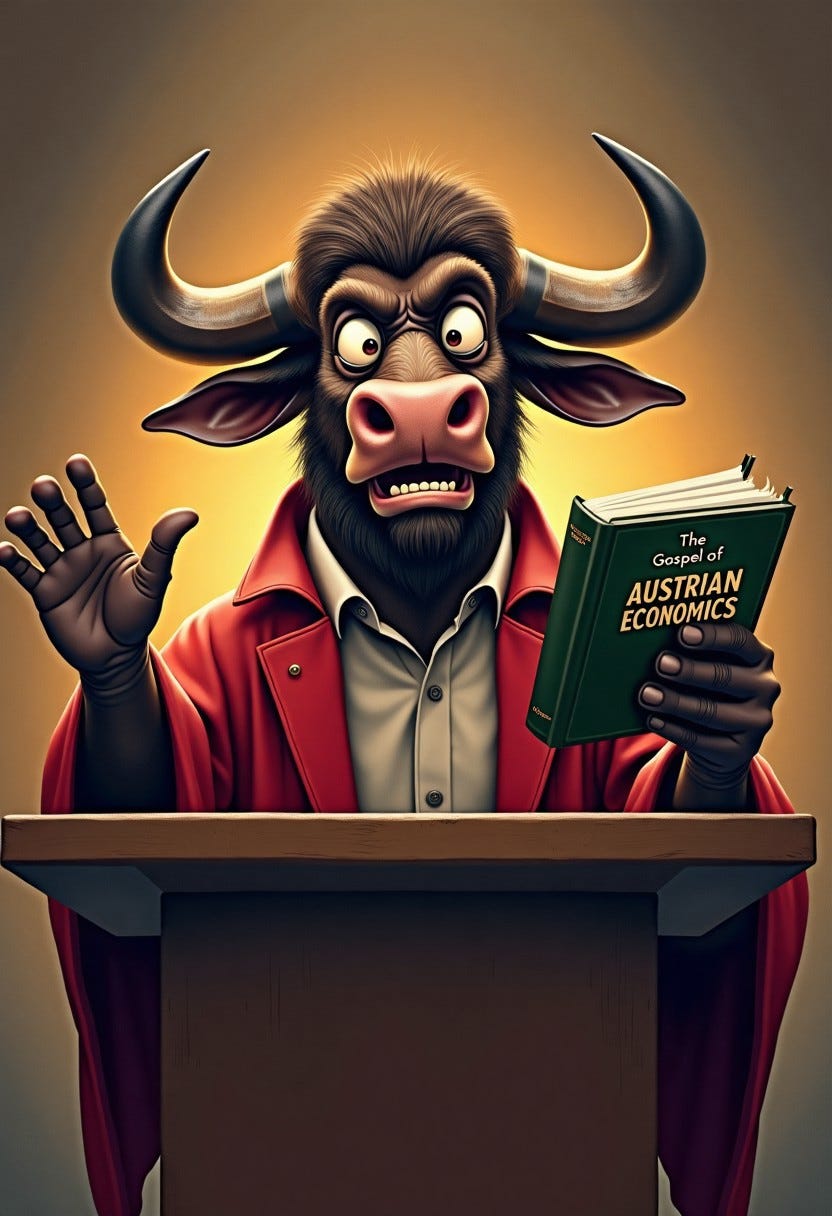
A meeting of Centerville’s Church of Austrian Economics has convened on a Wednesday night in contemporary times. The Right Reverend Buffalonius Ignatius Sage is presiding and will be preaching tonight.
What is a Church of Austrian Economics like? Allow me to explain.
What is about to happen is a rather whimsical creation, which encapsulates the style and intellect of the late Fredrich Hayek. emulated via style analysis, with an AI agent, of his writing from “The Road To Serfdom”. This discussion is in the first pages of their hymnal, you know, the one that no one reads unless the service is late or kids and adults get bored enough to read as they nearly doze off. YOU of course, are not one of THOSE people are you? That is why I left it here for you to read. It will come in handy later.
The rest of the posts will pretty much be me, but I decided to save time and assume the Church of Austrian Economics got text directly from the hand of Dr. Hayek. I had the AI agent create the magic. I wrote the original preamble to this post. It is not quite as complex as this is. This composition is made better as the content represents the late Mr. Hayek’s own perspectives very closely.
Stick with me folks, you will like the final results over the next few days. (And YES, I will finish the “Of Bullshit and Bitcoin” series!).
Here goes with the church doctrine.
A young church member, hesitant to remain still and impatient that the cute new girl, who just moved in, is late to the service, starts to read the hymnal. These are the words it contains:
The Church of Austrian Economics: A Philosophical Sanctuary in the Modern Age
Preface
It must be admitted that the manner in which contemporary society has come to organize its economic institutions bears little resemblance to the spontaneous order that once characterized the great commercial civilizations of the past. What we observe today is not the natural evolution of market processes, but rather the deliberate construction of artificial mechanisms designed to serve ends that, however noble in intention, inevitably lead us down a road toward economic serfdom. It is in this context that we must consider the emergence of what might be called the Church of Austrian Economics—not as a religious institution in the conventional sense, but as a philosophical sanctuary where the fundamental principles of human action and market coordination are preserved against the encroaching tide of central planning. The particular significance of this imagined institution lies not in its mythical character, but in its representation of those enduring truths about economic organization that have been systematically obscured by the prevailing orthodoxies of our time. There can be little doubt that the manner in which modern economic thought has abandoned the insights of Carl Menger, Ludwig von Mises, and their intellectual descendants has contributed substantially to the creation of the very problems that now plague our monetary and fiscal systems. The road we have traveled—from sound money to fiat currency, from spontaneous market coordination to bureaucratic intervention—has been paved with the good intentions of those who believed that conscious direction could improve upon the unconscious wisdom of the market process.
The Philosophical Foundation of the Sanctuary
The Church of Austrian Economics, as we might conceive it, stands as a testament to the proposition that economic truth cannot be discovered through the aggregation of statistical data or the manipulation of mathematical models, but only through the careful observation of human action in its most fundamental form. It is not sufficient to point out the defects of particular proposals based on Keynesian or monetarist reasoning; the argument for central planning will not lose its force until it has been conclusively demonstrated why what appears so eminently rational in the abstract becomes positively harmful when applied to the complex reality of human society. The essential method of this philosophical sanctuary would be the preservation and transmission of those insights that reveal the spontaneous order inherent in free market processes. What connects the various chapels and chambers of this imagined institution is not a shared commitment to any particular policy prescription, but rather a common understanding that the coordination of human activities cannot be achieved through conscious design, but emerges naturally from the voluntary interactions of individuals pursuing their own ends within a framework of general rules. The danger that confronts us in the present age is not merely the adoption of particular interventionist policies, but the acceptance of the fundamental premise that underlies all such interventions: the belief that human reason, however well-intentioned, can substitute for the information-processing capacity of the market mechanism. This belief, which has proved so seductive to intellectuals and policymakers alike, represents what we might call the "fatal conceit"—the assumption that what we can observe and measure constitutes the totality of relevant knowledge for economic coordination.
The Architecture of Economic Understanding
The physical design of our imagined sanctuary would necessarily reflect the decentralized nature of market processes themselves. Rather than a single, imposing structure dominated by a central authority, we would find multiple chapels, each dedicated to a particular aspect of economic understanding, connected by open pathways that allow for the free flow of ideas and insights. This architectural arrangement serves as a metaphor for the spontaneous order that characterizes genuine market economies—a system in which coordination emerges not from central direction, but from the voluntary interactions of countless individuals, each possessing only fragmentary knowledge of the whole. The central atrium of this structure would be illuminated by natural light streaming through a glass roof, symbolizing the transparency that characterizes genuine market processes. Here, beneath the watchful gaze of a statue commemorating Carl Menger— the founder of the Austrian school—visitors would encounter the fundamental insight that economics is indeed "the science of human action." This inscription serves not merely as a historical reminder, but as a constant admonition that economic phenomena cannot be understood apart from the purposeful behavior of individual human beings. (My words here, this will be central to the sermon that comes soon enough!)
It is particularly significant that such a sanctuary would eschew the grandiose monuments to state power that characterize so many public buildings in our time. The modest scale and human proportions of the structure would reflect the Austrian understanding that economic progress emerges not from the grand designs of planners and bureaucrats, but from the countless small innovations and adaptations of ordinary individuals responding to the opportunities and constraints they encounter in their daily lives.
The Liturgy of Market Wisdom
The worship practices of this philosophical sanctuary would center not on the veneration of particular individuals or institutions, but on the celebration of those principles that make peaceful cooperation possible among strangers. The hymns and canticles that might echo through its halls would serve to remind participants of the miraculous nature of market coordination—the fact that millions of individuals, pursuing their own diverse ends, can be led by an "invisible hand" to promote the general welfare more effectively than any conscious attempt at social engineering. Consider, for instance, what we might call "The Canticle of the Entrepreneur"—a celebration of that crucial figure who serves as the driving force of economic progress. The entrepreneur, in the Austrian understanding, is not merely a profit-seeker, but a discoverer of previously unrecognized opportunities for mutual benefit. Through the exercise of judgment under conditions of uncertainty, the entrepreneur serves as the agent through which the market process continuously adapts to changing circumstances and discovers new possibilities for human cooperation. Similarly, the hymn dedicated to the "invisible hand" would serve to remind participants that the coordination achieved through market processes does not require conscious intention on the part of market participants. The baker who provides bread for his community does so not out of benevolence, but in pursuit of his own livelihood; yet the result of his self-interested action is the satisfaction of genuine human needs. This insight, first articulated by Adam Smith and refined by subsequent Austrian theorists, represents one of the most profound discoveries in the history of social thought. The liturgical calendar of such an institution would mark not the feast days of saints, but the anniversaries of those intellectual breakthroughs that have advanced our understanding of market processes. The publication of Menger's "Principles of Economics" in 1871, the appearance of Mises's "Human Action" in 1949, the awarding of the Nobel Prize to Hayek in 1974—these would be occasions for reflection on the gradual accumulation of insights that have illuminated the workings of the market economy.
The Congregation of Economic Understanding
The membership of this philosophical sanctuary would necessarily be diverse, reflecting the universal applicability of Austrian insights to human action in all its forms. We would find among the congregation not only professional economists and business leaders, but teachers and students, craftsmen and artists, farmers and technicians—all united by a common appreciation for the spontaneous order that emerges from voluntary exchange. The men of this community might be depicted as entrepreneurs and scholars, bearing the symbols of their trades—ledgers and scales, coins and contracts—representing their role as agents of economic coordination. But it would be a mistake to view them merely as profit-maximizers; they are, more fundamentally, discoverers of opportunities for mutual benefit, constantly alert to the possibility of creating value through new combinations of resources and new forms of cooperation. The women of this congregation would be portrayed as educators and business leaders, holding books of economic theory and keys to prosperity, symbolizing their crucial role in the transmission of knowledge and the cultivation of economic understanding. In the Austrian view, the market economy depends not merely on the pursuit of individual advantage, but on the gradual accumulation and dissemination of practical knowledge about how to coordinate human activities effectively. The children present in this community would be shown as eager learners, equipped with small models of markets and exchanges, representing the next generation's introduction to the principles of voluntary trade. Their presence serves as a reminder that economic understanding is not merely an academic exercise, but a practical necessity for anyone who hopes to navigate successfully the complex web of relationships that characterizes modern society. This diverse congregation reflects the Austrian insight that market processes serve not the interests of any particular class or group, but the general interest in peaceful cooperation and mutual benefit. The market economy is not a zero-sum game in which some must lose in order for others to win, but a positive-sum process in which voluntary exchange creates value for all participants.
The Contemporary Relevance of Ancient Wisdom
The particular urgency of preserving and transmitting these insights becomes apparent when we consider the economic challenges that confront contemporary society. The inflation that erodes the purchasing power of ordinary citizens, the unsustainable accumulation of government debt, the regulatory barriers that stifle entrepreneurial innovation—all of these problems can be traced to the abandonment of sound economic principles in favor of the seductive promises of central planning. The Austrian understanding of monetary theory provides a clear diagnosis of the inflationary pressures that have become endemic in modern economies. When governments and central banks expand the money supply beyond the rate of economic growth, they inevitably create distortions in the price system that lead to malinvestment and economic instability. The boom-and-bust cycles that have characterized recent decades are not natural features of market economies, but artificial creations of monetary manipulation. Similarly, the Austrian analysis of government intervention reveals why well-intentioned policies so often produce results that are the opposite of what their advocates intended. Price controls designed to make goods more affordable inevitably create shortages; minimum wage laws intended to help low-skilled workers often price them out of the job market; regulations designed to protect consumers frequently serve to protect established businesses from competition. The road back to economic sanity requires not merely the adoption of particular policy reforms, but a fundamental reorientation of our thinking about the proper role of government in economic life. It requires recognition that the market process, however imperfect it may appear to those who judge it by impossible standards of perfection, represents the most effective mechanism yet discovered for coordinating the activities of millions of individuals in pursuit of their diverse ends.
The Warning of History
The history of the twentieth century provides ample evidence of what happens when societies abandon the principles of market coordination in favor of central planning. The totalitarian regimes that emerged in Russia, Germany, and elsewhere were not aberrations, but logical consequences of the attempt to organize entire societies according to conscious design. When economic power is concentrated in the hands of political authorities, it becomes impossible to maintain the separation of powers that is essential to political freedom. This is the central insight of "The Road to Serfdom"—that economic freedom and political freedom are inextricably linked. A society that abandons market coordination in favor of central planning will inevitably find that its political institutions become instruments of economic control. The planners who promise to use their power only for benevolent purposes will discover that the logic of planning requires them to suppress dissent and eliminate opposition. The Church of Austrian Economics, as we have imagined it, serves as a repository of this hard-won wisdom. Its very existence represents a recognition that the insights of the Austrian school are not merely academic curiosities, but practical necessities for anyone who hopes to preserve the institutions of a free society. The principles enshrined in its teachings—the importance of sound money, the benefits of free trade, the necessity of property rights, the dangers of government intervention—are not abstract theories, but concrete guidelines for the organization of human society.
Conclusion: The Eternal Vigilance of Economic Understanding
The particular significance of this imagined sanctuary lies not in its mythical character, but in its representation of the eternal struggle between those who understand the spontaneous order of market processes and those who believe that conscious design can improve upon the unconscious wisdom of voluntary exchange. This struggle is not merely academic, but intensely practical, for upon its outcome depends the future of human freedom and prosperity. It must be acknowledged that the forces arrayed against economic understanding are formidable. The intellectual classes, seduced by the apparent rationality of central planning, continue to advocate policies that undermine the very foundations of market coordination. The political classes, attracted by the promise of power that comes with economic control, resist any limitation on their authority to intervene in market processes. The general public, lacking adequate understanding of economic principles, often supports policies that promise immediate benefits while ignoring their long-term costs. Yet the Church of Austrian Economics, as we have conceived it, represents the possibility that economic truth can survive even in an age of widespread error. Its congregants, however few in number, serve as guardians of insights that have the power to illuminate the path back to economic sanity. Their commitment to the principles of human action, spontaneous order, and voluntary exchange represents not merely an intellectual position, but a moral stance in favor of human freedom and dignity. The road to economic serfdom is paved with good intentions, but the road back to freedom requires more than good intentions—it requires understanding. The Church of Austrian Economics, in all its imagined glory, stands as a symbol of that understanding, a beacon of hope in an age of economic confusion, a reminder that the principles of market coordination, however unfashionable they may become, remain as relevant today as they were when first discovered by the great economists of the Austrian school. In the end, the survival of free institutions depends not on the wisdom of political leaders or the benevolence of bureaucrats, but on the understanding of ordinary citizens who recognize that their prosperity and freedom depend upon the preservation of those spontaneous processes that make peaceful cooperation possible among strangers. The Church of Austrian Economics, as we have imagined it, serves as both a celebration of this understanding and a call to its preservation for future generations.
Back to our story!
The kid dozes off into nap-land, and his and several other hymnals hit the floor nearly simultaneously, causing outrage among the deacons and a call from a deacon to refrain from noise as the Right Reverend Sage has been delayed. What was also delayed were pre-service refreshments and the fact that the sermon was called in the main sanctuary on a June night after the heat outside hit 95 degrees Fahrenheit mid-day, causing a failure in the air conditioning system. The church treasurer ran short of money that week, so refreshments were not in the budget, and budgets are strict at the Church of Austrian Economics, let me tell you!
Could anything be worse in a sanctuary filled with charts, data tables, and overheated church members discussing and debating the key economic issues of the day?
All of a sudden when the din was uncontrollable, the sanctuary doors opened, and the tall-and-horned figure stood opposed to the bright sunset behind him outside the sanctuary. You could hear the snorts, and the congregation began to anticipate a face-ripper of a sermon from Brother Sage!
Gonna end it here. You will enjoy and I think learn from what is coming!