

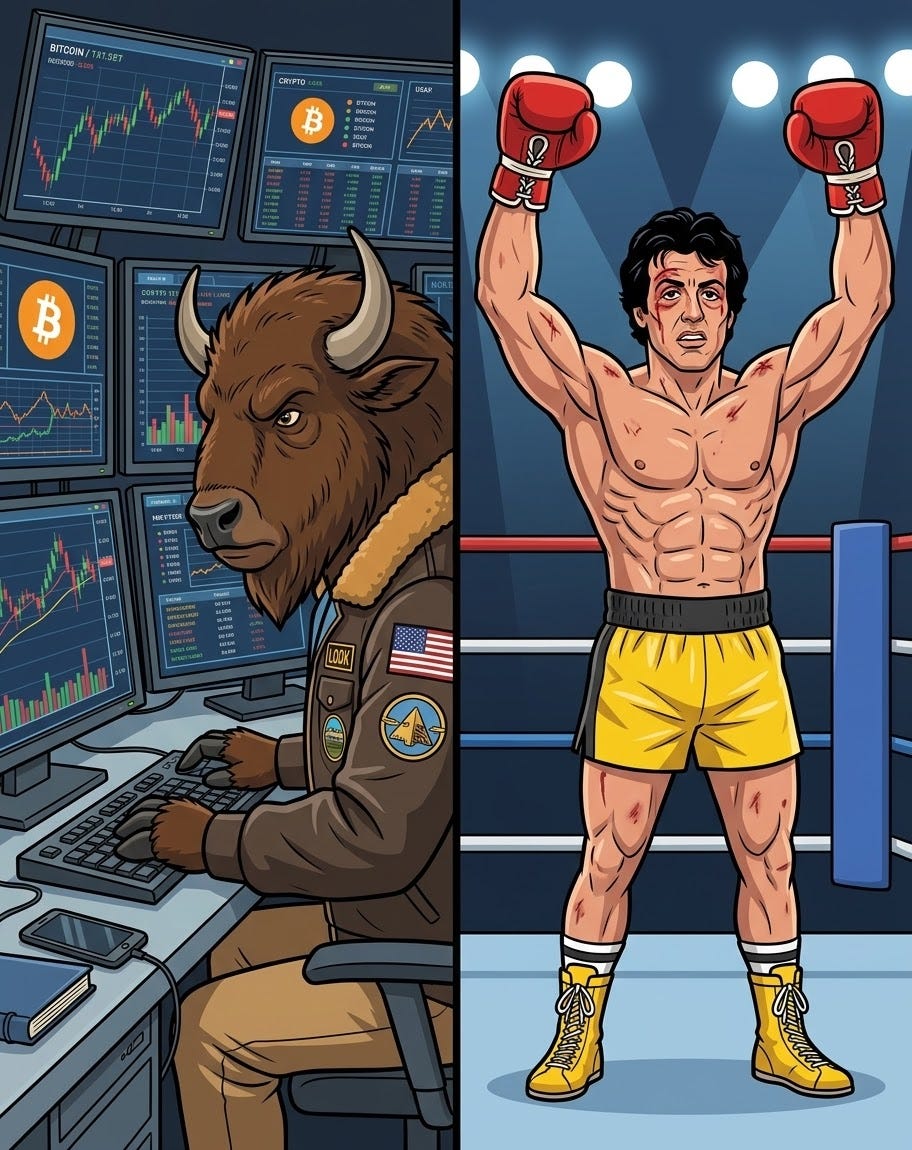
I had not read a non-fiction or biography in quite a while. As I am “Johnny Numbuhs” and someone who reads technical, history, and economics books, I figured I would take a break and read something that discussed someone’s struggle to achieve a goal. Stallone’s interview with New York Times writer Lulu Garcia-Navarro is interesting, but I wanted to really get a picture from Sylvester Stallone himself in written form both to get all his own words and to, in a way, judge his writing skills. I came away impressed with his book, The Steps, A Memoir The story is compelling and at times brutal, and his writing style is pretty crisp and down-to-earth. The book tells Stallone’s life story from birth up until the Academy Awards ceremony in 1977, 49 plus years ago.
What I intend to do with this article is to compare what you see in this video below (factors in becoming a successful trader) to the things that Sylvester Stallone did to become a successful actor and screenwriter. The parallels are quite close and quite daunting. If you really want to do something in your life, you have to follow a path that gets you to that particular goal. The video is below:
The key points of this video are designed to make you focus on what you need to do to succeed at trading. The examples are clear here. Trading is “easy” in relative terms, but learning how to do it profitably is difficult and needs to be a lifelong journey, as markets change.
Sylvester Stallone made his lifelong journey when he literally ended up with his back against the wall, and his only alternative for living was to pursue his dream and desire to be a successful actor/screenwriter. Did he have university-honed skills? NO. Did he have academic credentials? NO. He dropped out of the University of Miami a few credits short of a degree. Did he have money? HELL, NO! He was broke and pretty much destitute. He did have desire to succeed, and that sustained him. He followed many of the same principles discussed in that video for traders. I will outline them below and give you examples.
Stallone’s Steps
Own Every Result
In the video, the key to improving your trade profitability and your ability to stay in and grow the business is to own every order fill, every profit, and every loss you take. Blaming the market, the trading platform, the internet connection, and anything else wastes your time and emotion and teaches nothing. You have to work and to hone a trading plan that manages all of those outcomes effectively.
In Stallone’s case, he made several terrible gaffes early on that delayed his ability to be noticed and taken seriously. Before his success with Rocky, Stallone sold the rights to his script for Paradise Alley to Bob Chartoff and Irwin Winkler for $100. He sold it to the same two producers who would later make Rocky because he was desperate for money. He knew he had lost his nerve. He didn’t blame the producers or the business. He knew he had inner resolve, as he survived being put in jail and forced into a stint in a juvenile psychiatric ward (Chapter 24, Surviving the Snake Pit). He was not going to cave on the Rocky script until he got the film produced and with himself as the lead character, Rocky Balboa. In Chapter 27, “Do or Die, Sly”, he provides a deep analysis of his never-ending drive to get things done his way, knowing all of the pieces of his plan were in place.
Get Ready to Lose — Defense First
The trading rule is that losses are the cost of doing business! Job 1 is to protect your trading capital, THEN profits as they come in. You must define your stop loss point before you enter the trade! Skip anything and everything that doesn’t match your edge.
What is the parallel of the trader to Sylvester Stallone in this case? Stallone’s early New York years were a nearly continuous string of tiny losses, which he managed through a bit of cunning and survival mentality. He slept on pizza boxes, on buses and in flophouses (Chapter 27). Sly took a job cleaning the lion cages at the Central Park Zoo (Chapter 4) and took rejection after rejection. He nearly came to harm with his first acting audition. To keep his goal alive, he would usher at the Baronet and Coronet theaters to watch and to study movies, cinematography, and scriptwriting, while auditioning in his time off and writing at night. (Chapter 8). He continued to handle the losses (rejections for auditions), but earned enough on side jobs to keep moving forward with his goals.
By 1975 he reportedly had $106 in the bank and a pregnant wife. He sold his bull mastiff, Butkus. outside a liquor store in an act of desperation, because he couldn’t feed him. His defensive move was that he kept those losses small enough to survive. Odd jobs covered rent while the real position, writing and acting, stayed open. He and his wife, Sasha, moved to California to get exposure to the entire movie industry and to movie production with his meager assets.
Stallone treated survival jobs as his “stop-loss.” They capped the damage so he could still be in the game when the best set-up (a key audition or a key contact) arrived. A trader who protects capital through a drawdown is still at the table when the trade with the perfect edge set-up appears.
Master Your Emotions
Drawdowns are part of the “trading marathon.” The market doesn’t know you’re in a trade. The market doesn’t know you exist. Attempts to trade outside of the trades that fit your edge to earn trading losses back lead to revenge trading. That leads to even larger losses.
How does emotional control fit in Stallone’s situation on the road to success? Stallone took the hard line with respect to being paid for the script and for getting the lead role. The thing he did not want to was to become angry and lash out at the two producers. That kind of behavior had gotten him kicked out of school and, in one instance, sent to a psychiatric facility. He understood his edge and was unwilling to accept anything less than what he wanted.
Chartoff and Winkler offered up to $360,000 for the Rocky script, but the studio wanted an established star such as Robert Redford, Burt Reynolds, Ryan O’Neal or James Caan in the lead (Chapter 26). Stallone was broke and still refused to sell unless he played Rocky. That’s emotional discipline under maximum pressure. The desperate move and the most emotional move was to take the money. Even after United Artists agreed, he told the AP he feared every day on set might be his last (Chapter 34). He felt the fear and took the calculated risk, following his edge. He rigidly, doggedly, and purposefully followed his plan to the letter.
What he did, in trader-speak, was to avoid the emotional exit. The $360,000 offer was that “emotional exit.” He would have abandoned the plan, taken the money, and run. This is starting to sound like a Tony Robbins seminar promo, but you get the idea. He would have avoided the pain and gotten the immediate dopamine hit from a cash sum. Stallone sat through the pressure, determined to get what he planned on getting instead. Put yourself in Sly’s position and ask the video’s question. Each higher script bid would make you want to cave. Could you turn down five or six rising offers and still stay in position for the ultimate prize? This is particularly true if you are a scalper. When you know that it is the target or breakeven stop, do you hold out until you hit the target, knowing that it is the target or nothing? If the situation is a free move, then you are likely better to hold out than to fold. In real life in this case, Stallone had a pregnant wife who really wanted the security of cash flow. Could you hold out during those rejections on script fees and demands that other actors play Rocky (Chapter 26)? Sly held firm because he knew he had a strong hand.
Your Edge Has to Fit You
This is the trading rule that defines how you can trade with the most comfort for you. A defined, testable edge (including the trade win rate and reward-to-risk ratio) is required and you must be able to easily follow it, given your individual skill. (We will get into mechanical models much later, but for now, we are talking about you being at the controls of the trading platform.) As Van Tharp states in his most famous book, the so-called “holy grail” is a system that fits your beliefs and personality. To add an even more three-dimensional concept to Tharp’s concepts, Brett Steenbarger, from his own trade coaching book, suggests that traders should build on their strengths.
How does this trading rule fit the guy who invented the “Italian Stallion”?
Stallone’s “system” was built around what others called his weaknesses. Those very “weaknesses” combined with his strengths, a clear literary flair and a determination to put them into words, because Sylvester Stallone’s greatest strengths. A forceps injury at birth partly paralyzed his face, leading to his slurring of words and drooping features that seemed to rule out leading-man roles, which he discusses in great detail in Chapter 15. Rather than chase roles written for someone else, he wrote a character that fit him and his life perfectly. He wrote from the perspective of who he really was, a working class underdog from Philadelphia. He would often go to the library to read classic writers like Edgar Allan Poe, and lean upon the despair of their musings, only to turn the stories into the hope for redemption as Stallone wrote in Chapter 12, His true strength was telling hopeful stories cast within the street life in Philadelphia. When acting doors stayed shut, he leaned on the writing, then wrote himself into the lead. He built “an edge” only he could execute.
A trader, just like an actor or a screenwriter, running someone else’s system fights himself every day. Rocky was Stallone’s “perfect edge” set-up because it fit his personality and his situation like a glove. In Chapters 12 and 13, he goes through many iterations of this process with various screenplays (and he tested them all with producers), but Rocky was the pièce de résistance of all of his efforts.
The Five Self-Assessment Factors
The video’s five honesty questions line up with choices that Stallone made about how to pursue his career. Here they are below:
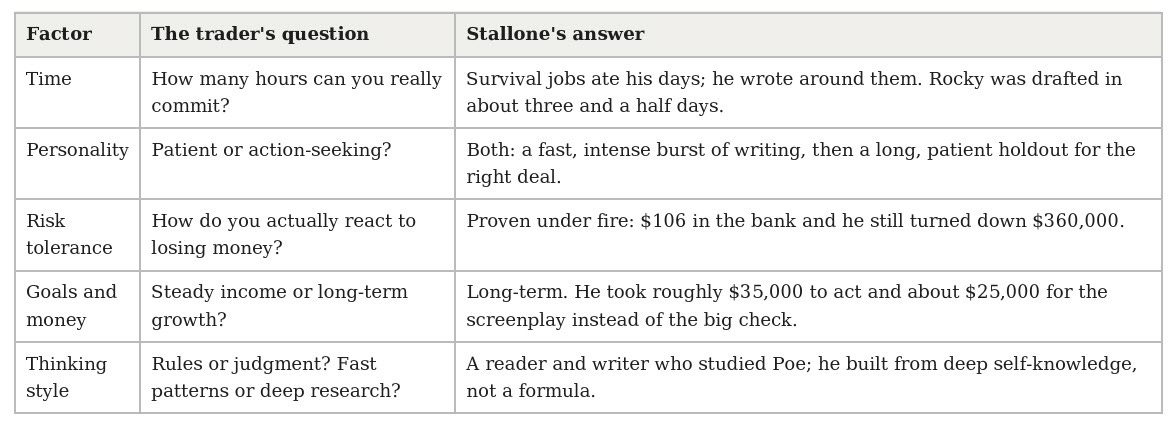
In terms of how Stallone models a trader’s formulation of trading assessment like an actor/screenwriter might have, In his own way, Stallone answered all five questions honestly before he made his “big bet." Most failed actors, like most failed traders, never ask the questions. If there is one thing that Sylvester Stallone did during those years between Miami and Los Angeles, it was that he persisted in learning his craft, writing and even acting, while flat-broke, and learning from every mistake he made. The Steps are a chronical of every mistake and roadblock he faced as he pursued his goal.
Test Before You Trust
This rule establishes the beginning of trading with real capital. Paper trade a real sample of your trading plan, journal your rules and your feelings (and that can take weeks to maybe even six months), then go live with a small capital position, one that will not damage you much if you lose. The demo will test the effectiveness of your strategy. The capital trade with real money will test YOU.
What was the analogy for this rule for Sylvester Stallone on his quest to get Rocky produced and distributed?
Stallone’s “paper trading” was six years of small parts and low-stakes reps, including The Lords of Flatbush in 1974. He earned 25 free T-shirts for that role, but he did it to improve his visibility. How is that for an “acting simulator”?
Each role tested whether he could execute on screen before anything big was on the line. When he finally went “live,” he went live small. Rocky was a low-budget film, roughly $1 million, and he took $35,000 to keep the lead. Of course, the points he was paid for revenues paid much more than that, but he wanted to be sure he could secure those points by getting the picture made. He kept the initial stake small to secure the larger payout later. It was, however, an all-out bet on his acting career, which I will discuss later.
Stallone didn’t bet his potential future as an actor an untested system. He built on every small success, – from his stage work in Switzerland and his softcore film work to The Lords of Flatbush, and his connections with producers in New York and in California. He made Rocky his first real “money trade,” knowing it would not end him if he failed. He tested himself, and learned the key lessons he needed to finally succeed.
Warning Signs a Style Doesn’t Fit
This is the rule that considers how well you have chosen your trading plan and trading method. Watch for breaking rules under stress, feeling drained, trading from boredom, or a plan that takes constant willpower. Treat them as a signal to adjust your trading plan and not as proof that you cannot trade.
How does that apply to Sly?
Stallone’s Paradise Alley screenplay sale was his warning sign. Because he was under financial stress, he broke his rule of staying with his initial price. He blew his first rule and gave in to the first solid dollar figure he could get. That happened to be $100.
He read that failure as a signal to change his approach, not a reason to quit. The next time, with the Rocky screenplay, he set the rule in advance. There would be NO deal if he didn’t star in the film, period.
One rule break under pressure isn’t the end of a career or an account. Repeating it again and again without correction is. Stallone adjusted after one costly lesson. He had lived with being called a failure since he was a kid. Sly was not about to give up on his best chance at winning.
Now Let’s Have A Conversation About How This Analogy Breaks Down
Survivorship Bias
There are certainly some differences between the video's trading rules and what what Sylvester Stallone did to bring his goals across the finish line.
For every successful actor like Sylvester Stallone, there are thousands of actors who held out and never got the deal. Others, like Patricia Arquette, granddaughter of comedian Cliff Arquette, started with family connections. Stallone had no connections other than the ones he created over time. He considers himself fortunate:
“It would be so disingenuous to say you’re an underdog, ‘as he said from his penthouse,’ Stallone said during a recent interview with the Associated Press, on a high floor of a luxury Manhattan hotel. “Yeah. Come on. I am a lucky dog.”
In real-time trading, brokers’ disclosures show the same pattern for short-term traders. The few who survive could be called fortunate, I guess, but if you have statistics from sizable numbers of trades in a variety of market environments, luck is where opportunity meets preparation. This is where position sizing comes in, and that is another area where Sylvester Stallone doesn’t fit a trader’s circumstances exactly.
Stallone’s holdout was a all-in bet with his career as an actor likely on the line, though is prospects as a writer might not have been. The video’s rule is 0.5%–1% of account risk per trade. The thing you should borrow from Sly is his discipline, not his position size. That is why survivorship bias is so brutal in trading. Could Stallone have taken a smaller trade than he did? Probably not, because you cannot risk 0.5% of a movie. The minimum account size for that trade was $1 million, though that money was United Artist’s and other investors, so you might infer that his trade was highly leveraged by the partners in the film. That is why so many entrepreneurs (and movie producers and private LLCs) go bankrupt making movies.
Summary
The most important factor in Stallone’s success wasn’t the script, the studio or that Hollywood had produced over 300 boxing movies before Stallone showed up (Chapter 27). It was Sylvester Stallone himself. He owned his results, survived the drawdowns, and mastered his emotions, which were at times tumultuous. He built an edge that fit him and tested it before he bet on it.
As a trader, that is what you have to do. I may be alone in saying this, but I will say it anyway. If you are an investor of any kind, you are a trader. If you have no idea no idea when to enter and exit, you will one day get burned. I will discuss that issue in a upcoming post for this Substack!
Thank you for supporting the Buffalo Trader’s Writing Desk! If you like what you read, consider becoming a paid subscriber. If I can get to 1,000 paid subscribers, I can really transform this Substack into the publication that the old The Buffalo Trader blog was from 2008–2014, and, before that, a critical part of what was once the most-read trader’s website on the planet from 2002 to 2008. It might never happen, but you never know!
Have a great week everyone!
Great advice here!