

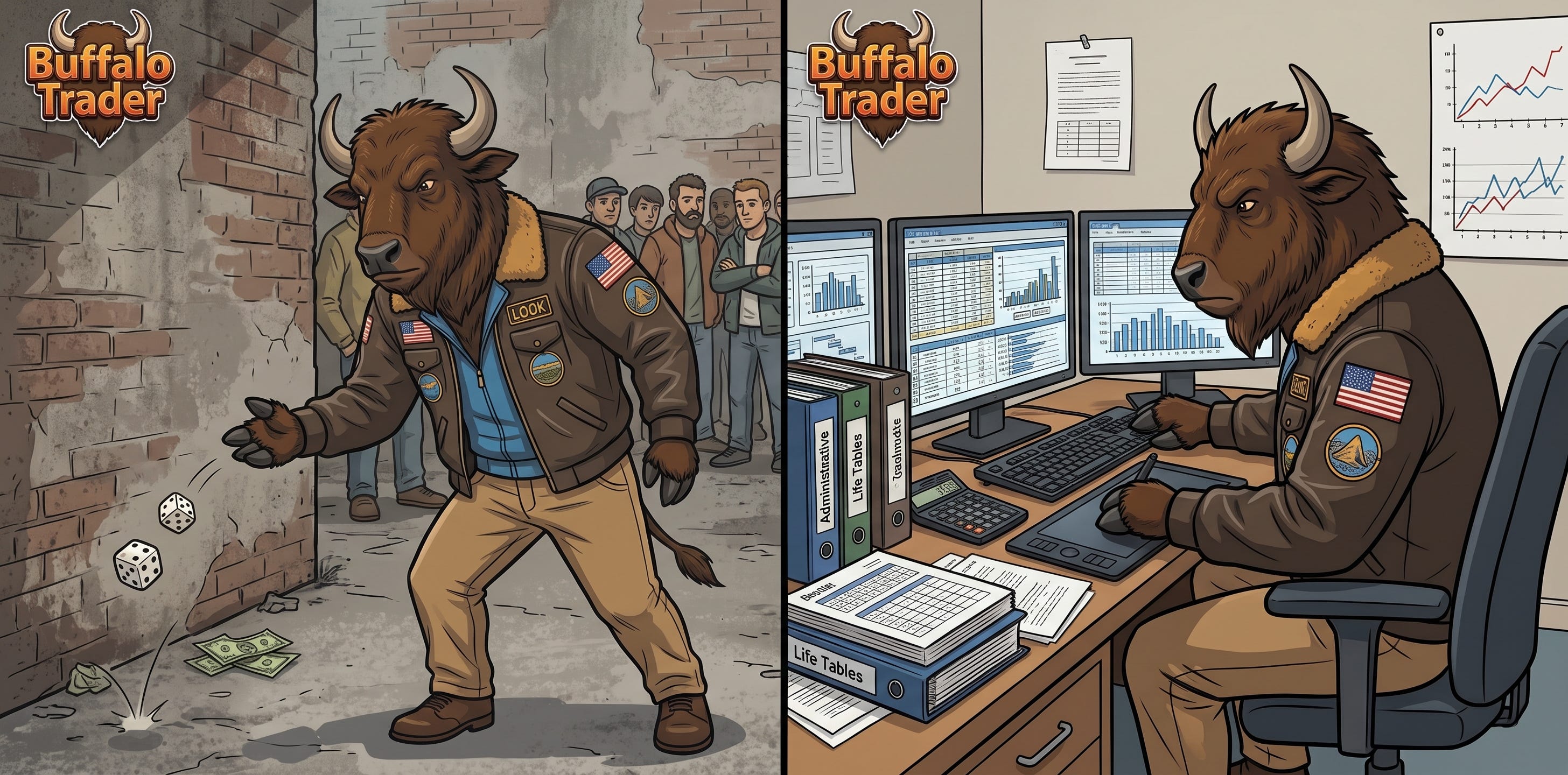
You probably have to be a dinosaur to know the song Stagger Lee which was a traditional folk ballad based on the 1895 murder of Billy Lyons by Lee Shelton in St. Louis. It was first made popular in the United States by Fred Waring and the Pennsylvanians (yes, the guy who gave you the Waring blender). Lloy Price made a popular hit of it in 1958. You can hear it by clicking on the link.
Why would I bring up that deep level of worthless trivia? I did so to emphasize the insanity of gambling and the ruinous effects it has on the lives of gamblers. Besides breaking bartender’s glasses, it can ruin your financial future.
Please watch this video, because it describes the process of using a trading model that has a positive expectancy, that is, a profitable edge that can remain so as long as the model has been backtested, the written rules are followed, and the orders are placed properly for stops. That process will help you limit the total risk per trade to 1% of the account. That is a typical maximum loss any trader should take, particularly on futures trading accounts.
It is critical to understand is what the 1% rule means. If you have created a written and easy-to-execute trade plan that has been rigorously backtested, then you know what the maximum amount you can risk on any trade, and that is defined by the 1% rule defined in this video. You are not Stagger Lee, that rather degenerate gambler. You are like an insurance actuary who knows the maximum amount you can lose and still remain profitable if your trading edge holds. You want the profit from wins to exceed the losses, even if the model can only win less than 50% of the time.
By the way, you can set your rule for losses to less than 1%, but you must realize that if you do, price volatility may stop you out even more. You would have to test your edge for larger gains or for measured gains (figured out from what a maximum positive excursion of price to a price target). I will get into that later in this series.
You will also have to use limit orders (in my opinion, based on experience) because there will be more chance for slippage (that is a price fill that is distant from the price entry you calculated) if you go with a market order. We will cover that in future articles also.
The other thing about this video that I will need to clarify further, as there is a tiny editing error in it, is that NOT every bar is a tradable bar. In most cases, other factors than a simple breakout to the up side of a previous high is qualified as a breakout trade. You would need to follow your rules perfectly without exception than to trade every bar for which the rules apply.
The other restriction that is critical to your trading is to NOT exceed a maximum loss for the day, EVER. If you do that, you will empty your trading account like a full and punctured plastic bottle. You must set strict limits to prevent silly things like revenge trading.
Moving forward, I will discuss these key topics to get your terminology in order and to give you a solid footing before even starting to trade in simulation. You should do for three to six months or longer until you gain confidence in the trading environment with real money.
I will be covering Bitcoin when things look interesting. Bitcoin is showing weakness this afternoon, but with all that is going on in equities and commodities, it is going to get kicked around in a similar fashion with gold and silver. More will be coming soon.
Thank you for reading and supporting the Buffalo Trader’s Writing Desk! We are approaching 500 subscribers which we appreciate. If you like this content, click the like button and consider being a paid subscriber. I will add more to the content and make this channel even more helpful and research packed than it is now!
Have a pleasant and productive week!