

Here come the trite quotations (please read them and do not fall asleep):
"Rule No. 1: Never lose money. Rule No. 2: Never forget Rule No. 1.” -Warren Buffett
"Throughout my trading career, I have continually witnessed examples of other people that I have known being ruined by a failure to respect risk. If you don’t take a hard look at risk, it will take you". - Larry Hite from “The Rule”. He further explains that even a poor trading system can be profitable with proper money management, highlighting the importance of controlling risk over chasing returns.
"I believe in defining my risk. I don’t believe in defining my reward." Tom Hougaard from “Best Loser Wins.”
Even Warren Buffett knows that everyone WILL lose money at some point in investing and trading. Regardless of what the investing moralists claim, trading and investing are both the same. The only difference in them is the amount of time you intend to hold the trade. To this day, based on a conversation I had with one of Buffett’s options traders in the 1990s, I still believe that Charlie Munger was the true brains of Berkshire-Hathaway. Why? Because he helped Mr. Buffett extend his level of risk through hedging, which is what the gentleman, who was an options trader for Berkshire-Hathaway I met in Atlanta. told me. Munger knew more than anyone (and if you have understood his life story, you would see this) that every move investment or anything in life has a downside, and you must ALWAYS protect yourself from the downside, no matter what.
As time progresses I will show you how all the factors of my trade plan work together. What I first want traders (particularly new ones) to understand is this. Everyone can dream of their fantasy life where everything works and the money flows like an endless river of stress-free wealth. That is absolutely NOT going to happen. You have to manage risk and loss at the beginning before you can ever make money in trading or investing.
Let’s look at how this model performed showing only winners with the newly evolved model, using only 1 contract. Remember, this is primarily a “breakout model” but it has an extension as long as one can scale the model over time. Assume I took off those days shown in black, being the perfected trader that I am (NOT). The month of October 2025 looked like this:
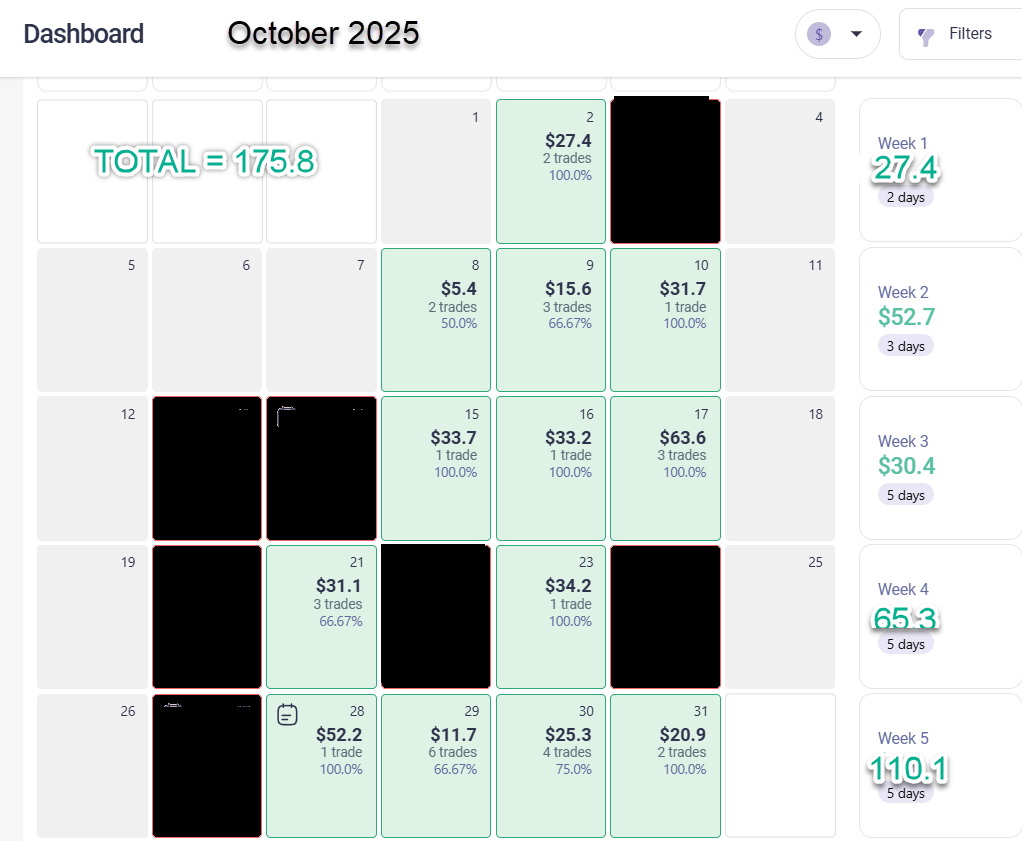
On a micro-NQ contract (MNQZ25), I would have netted $175.80 after commissions. On a normal mini-contract, that would have been $1758.00. Not bad actually for about an average of 90 minutes of work in the morning.
Now let’s show you what the model really did, before any adjustments were made to the model, but including every error and every loss (there were actually both in this model).
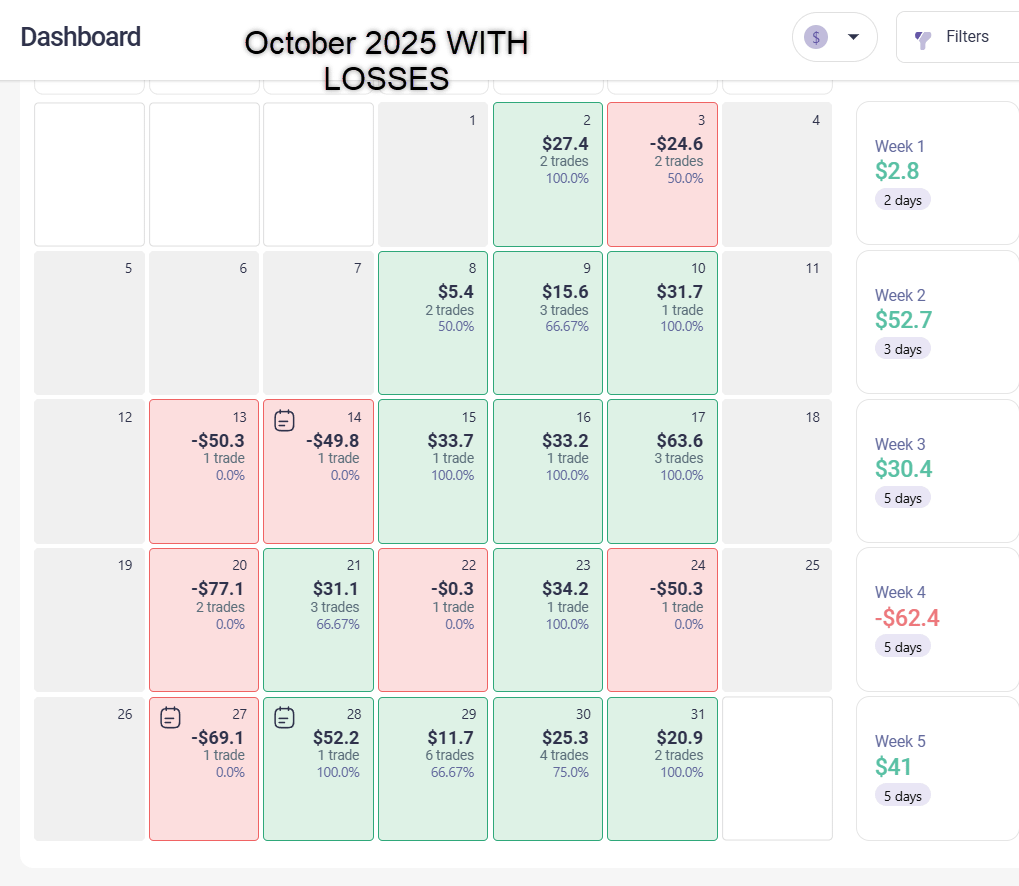
The total gains were $64.50. Several things went wrong:
Stops were hit, which if they’re hit twice, ends my trading day, even if not in sequence.
I did not allow the trades to run fully, as I set a target that the market took out (something I will discuss later in volume profile analysis and in other ways).
I entered several trades (three to be exact) too early, something I have worked out to a large degree with the re-engineered ratio indicator (for volume imbalance).
What this demonstrates is:
The ABSOLUTE necessity to keep a trade journal.
The ABSOLUTE need to keep charts with your trade journal so you can fully understand when where how and why you want wrong, and to help you to study where proper stop losses need to be place. I will discuss this in greater detail later.
A way to fully review what you are doing wrong so that you can quantify the errors and minimize them as you trade more. You do not learn anything from successful trades all that much. You learn EVERYTHING from the losers, as it helps you not to make the same mistakes again.
I am still working up spreadsheets, and as I finish another project this afternoon, I will go back to this project, including updating the re-engineered ratio indicator to the most current data I have.
If you are not doing this process for yourself as a trader, you could just be wasting your time trading. You should contently assess your process and make adjustments.
More will be coming soon. Thank for your supporting The Buffalo Trader’s Writing Desk. Happy New Year!
I like the emphasis on defining risk instead of chasing reward, and the reminder that money management matters more than any single system. The transparency around showing both wins and losses is refreshing.
What’s the one risk rule you think newer traders struggle with the most when they start applying this kind of model?
I’ve subscribed and would be happy to support each other.
Jorrit