

A little background on this video. I was for a very long time a position trader and a swing trader (and I guess I always will be), but when I became disgusted with ZIRP (zero-interest-rate policy) and the bubble that was created from that, I shifted away from stocks and began to trade stock index futures and to invest in real estate. The reason was simple for me. The liquidity was incredibly good, and leverage (at times up to 500x if the contract and the volatility was right) made profits easy to manage. From 2008 until Fed Chairman Jerome Powell began his efforts to raise interest rates in December of 2018, the volatility on MNQ and NQ was really tame. I could trade DeMark pivots with relatively tight stops and make money.
The fall of 2018 changed all of that, as markets began to roil at the audacity of some Fed chairman actually trying to bring the time value of money back into existence again!
The DeMark pivot methods I used began to fail failure miserably, and as a result I needed to find a better method to discover and exploit volatility which had suddenly become a thing in stock index futures. What I did was to blend volume profile analysis for gaps in commercial interests and methods like the opening range breakout method (ORBS), of which there are many variants, back into play to exploit the larger movements. It by and large worked and they have continued to work as I refined them.
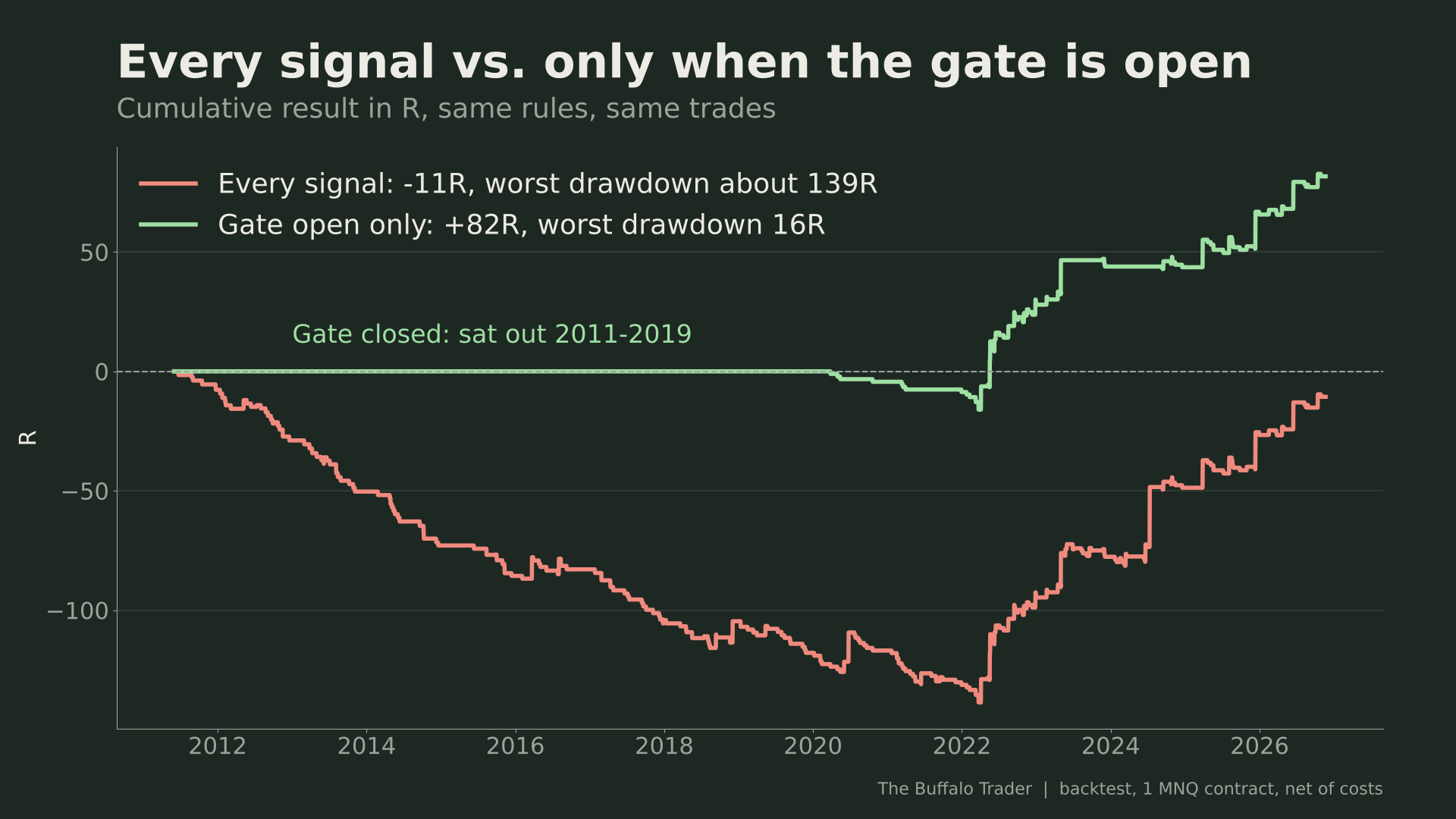
While I will not discuss that method with you, as you need to find what works best for your risk profile and your personality, I will discuss why I began to study and use average true range (ATR) as a stop mechanism. I also did a reverse analysis to prove that my ORBS trading method, which was fine when in 2019, blew up in all years prior to that. I decided to take my modified ORBS strategy and test it across the entire life cycle (this far) of MNQ. What I found was astounding.
This video explains the first half of it. As you can see from the chart, had I traded the way I did after 2019 back in 2011, I would have blown up an account. The reason for that is that average true range was expanding as prices became more volatile. Without volatility, that strategy will fail.
But even WITH volatility, there must be away to adjust ATR to cope with it profitably. You can also use ATR to tell you when to trade the model and when to stop trading the model. That will be further discussed in the video that will be released on Sunday.
The first video of this series that premieres at 1900 EST tonight is below:
If you have any questions about this video, fire away! I will do my absolute best to explain it to you.
Thanks again for supporting the Buffalo Trader’s Writing Desk! If you want to support my research, consider becoming a paid subscriber. I could do a ton more of market specific work if I had enough subscribers to justify the investment. If you like the post and the video, hit that like button too!
Everyone in the USA, have a wonderful Thanksgiving, and to the rest of you, have a pleasant and productive week!